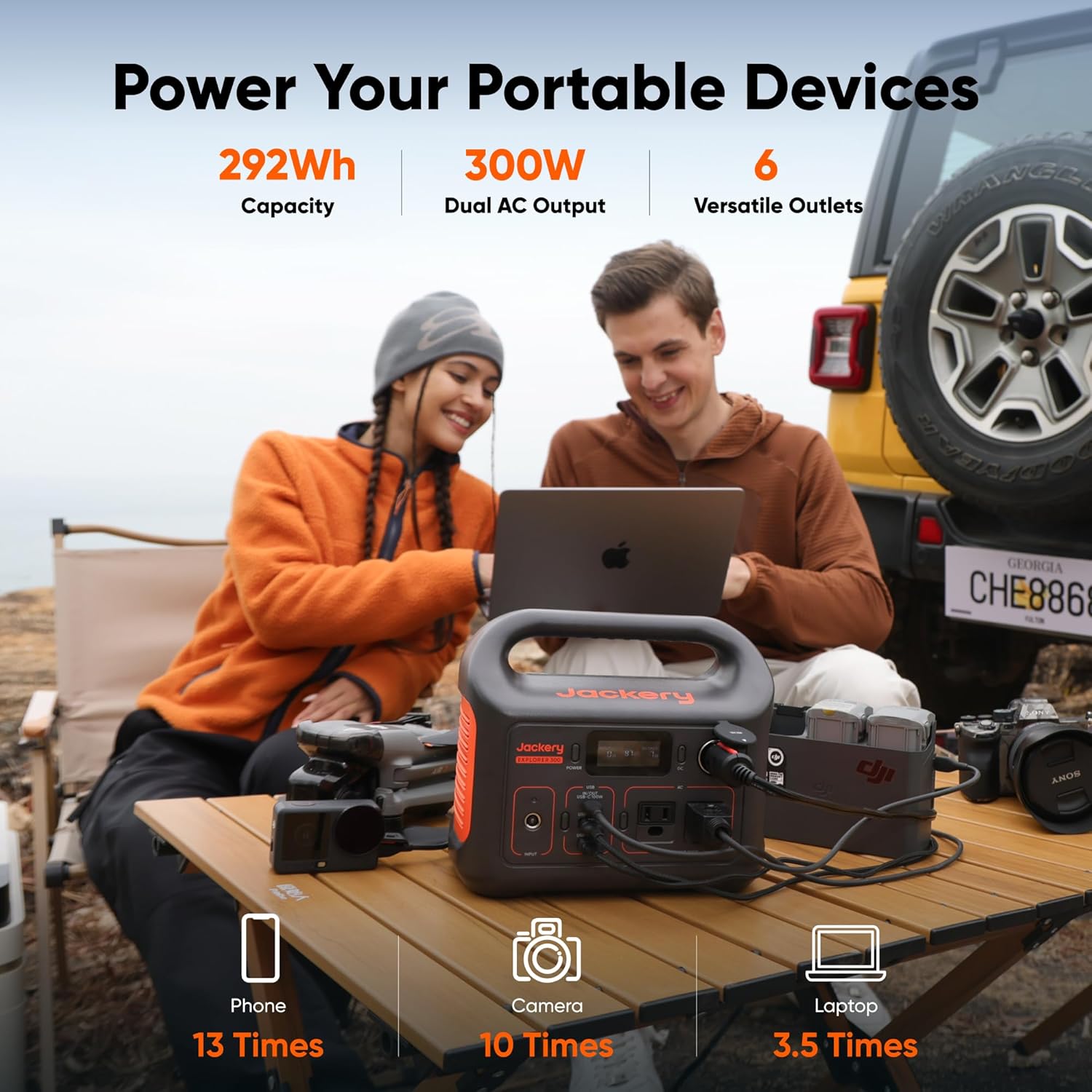
A solar generator bundle is exactly what it sounds like: a portable battery station (think of it as a big rechargeable power brick with multiple outlets) sold together with one or more folding solar panels that recharge it from sunlight. You plug the panel into the station, set it in the sun, and the battery fills up — no grid connection required. That stored electricity can then power a laptop, run a CPAP machine, keep a mini-fridge humming for a few hours, or charge a phone dozens of times. Below $600, you’re shopping in the entry-to-mid tier of this market, dominated by brands like Renogy, EcoFlow, Goal Zero, and Jackery. This guide exists because the marketing specs on these bundles are almost universally optimistic, and the gap between what a kit claims and what it delivers on a real campsite or in a real grid-outage is where most buyers get surprised. We’ll close that gap before you spend a dollar.
| EDITOR'S PICK[Jackery Solar Generator 1000 v2](https://www.amazon.com/dp/B0D2L1G66J?tag=greenflower20-20)… | Mid-tierPortable Solar Generator | Budget pick[EnginStar Portable Power Station](https://www.amazon.com/dp/B09SHB84J2?tag=greenflower20-20) | |
|---|---|---|---|
| Capacity | 1070Wh | 280Wh | 296Wh |
| Inverter power | 1500W | 300W | 300W |
| Battery type | LiFePO4 | — | Lithium |
| Solar panel wattage | 200W | 60W | — |
| USB-C output | 100W | — | — |
| Fast charge <2hr | ✓ | — | — |
| Price | $599.99 | $160.62 | $145.99 |
| See on Amazon → | See on Amazon → | See on Amazon → |
How the Math Actually Works (And Where It Breaks)
The most important number on any solar generator bundle is the power station’s capacity, measured in watt-hours (Wh). One watt-hour means you can run a one-watt device for one hour, or a 100-watt device for about six minutes. Most bundles under $600 pair a 200–300 Wh station with a 60–120W solar panel.
Here’s where the optimism creeps in: the panel wattage (say, 100W) is a peak rating measured in a lab under ideal conditions — perpendicular sun, 77°F, no clouds, no dust, no angle losses. Per NREL’s Best Research-Cell Efficiency Chart and its associated field-performance documentation, real-world solar panel output typically runs 70–80% of nameplate wattage under good outdoor conditions, and can drop to 50% or lower on overcast days or with suboptimal panel angles.
By the numbers — a realistic 100W panel over 5 hours:
| Scenario | Estimated Output |
|---|---|
| Lab-rated peak (100W × 5 hrs) | 500 Wh |
| Good conditions, 75% efficiency | 375 Wh |
| Partly cloudy, 50% efficiency | 250 Wh |
| Overcast / shade | Under 100 Wh |
If your bundle includes a 256 Wh station and a 100W panel, you realistically need 4–5 solid sun-hours to fully recharge the station from empty under good conditions — not the 2.5 hours some listings imply. The difference matters if you’re planning multi-day use.
The second efficiency loss most buyers miss: the charge controller built into the station. Every bundle in this price range uses either PWM (pulse-width modulation) or MPPT (maximum power point tracking) charge control. MPPT controllers harvest 10–30% more solar energy than PWM by continuously optimizing the panel’s electrical operating point. EnergySage’s portable solar overview notes that MPPT has become standard on mid-tier stations — but not all budget bundles have made the switch, and the spec sheet won’t always make it obvious. Worth confirming before you buy.
What the Leading Bundles Actually Include
In this price band, four configurations show up repeatedly in aggregated buyer reviews and in coverage from Wirecutter’s portable power station roundup (updated 2025) and Consumer Reports’ portable power station ratings.
The ~$300–$400 entry point: Bundles at this tier typically pair a 150–200 Wh station with a single 60–80W folding panel. The EcoFlow RIVER 2 (256 Wh) with a 60W panel hits this window when bundled during promotional periods. Owners consistently report that this pairing works well for phone charging, camera gear, and LED lighting but falls short for laptop-heavy days or any appliance above 200W continuous draw. EcoFlow’s published specs put the RIVER 2’s maximum output at 300W AC — more than sufficient for most consumer electronics, though the battery capacity will drain quickly under sustained load.
The ~$500–$600 sweet spot: This is where bundles start including 100W panels and 250–300 Wh stations, a configuration that actually covers a meaningful range of outdoor-power use cases. Jackery’s Explorer 300 Plus with a 100W SolarSaga panel, and Renogy’s PHOENIX 300 bundled with its 100W foldable panel, both land here depending on current pricing. Reviewers at Wirecutter note that Jackery’s bundles consistently earn high marks for user-friendliness and build quality, while Renogy’s ecosystem appeals to buyers who are already running or planning a 12V vehicle system and want panel compatibility across applications. Goal Zero’s Yeti 200X paired with a Nomad 50W panel tends to come in slightly under $500 but offers less raw capacity — the Goal Zero product documentation rates the Yeti 200X at 187 Wh, making it better suited to single-night trips than multi-day expeditions.
What you won’t find under $600: LiFePO4 (lithium iron phosphate) chemistry at meaningful capacity. Most stations in this tier use standard lithium-ion (NMC or similar). LiFePO4 offers a substantially longer cycle life — typically 2,000–3,500 cycles versus 500–800 for standard lithium-ion — but the chemistry commands a price premium that pushes most LiFePO4 bundles above $700–$800. If longevity and daily-use durability are priorities (van life, frequent overlanding), budgeting above $600 specifically for LiFePO4 is worth the math.
The Tradeoffs Nobody Puts on the Box
Inverter quality and the “pure sine wave” question. The AC outlets on portable stations output power in one of two waveforms: modified sine wave or pure sine wave. Modified sine wave is cheaper to produce but can cause problems with certain loads — some CPAP machines, variable-speed motors, and sensitive electronics may run poorly or not at all. All mainstream brands in this segment (EcoFlow, Jackery, Renogy, Goal Zero) publish pure sine wave AC output on their stations, but double-check your specific model’s spec sheet, because not every SKU at every price point is the same.
Panel portability vs. panel efficiency. Folding panels in this tier are almost universally monocrystalline silicon, which NREL’s cell efficiency data confirms is the practical efficiency ceiling for mass-market portable panels. The real variable is the folded footprint and weight. A 100W panel might fold to the size of a large briefcase at 7 lbs or to a thicker, heavier package depending on construction. If you’re backpacking, even 7 lbs is significant; if you’re car camping or van-dwelling, it likely isn’t. Owners on extended van trips consistently report that rigid panels mounted to a roof deliver meaningfully higher daily yield than folded panels placed on the ground, simply because fixed mounting allows continuous optimal angle without manual adjustment.
Expandability (or the lack of it). Most bundles under $600 are closed systems — the panel connects to the station, period. Some Renogy and EcoFlow configurations allow you to chain additional panels or connect to a separate battery bank, but this typically requires additional accessories and planning. If you expect your power needs to grow — more devices, longer trips, emergency home backup ambitions — buying into an expandable ecosystem from the start is worth the marginal cost.
Warranty depth. This is where the brands diverge meaningfully. Goal Zero and EcoFlow both publish 24-month warranties on their stations as of 2025 documentation. Jackery’s warranty terms are similar on paper but owners in long-run reviews note that the claims process experience varies. Renogy’s warranty documentation covers panels and stations separately. The practical consideration: a $350 power station with a 12-month warranty is a different risk calculus than a $450 station with 24 months and documented customer support. Consumer Reports’ portable power station ratings call out warranty and support quality as a significant differentiator in this segment.
Decision Rules: Which Bundle for Which Buyer
The spec sheets and aggregated reviews point to a few clean decision rules.
If your use case is weekend camping and device charging (phones, cameras, small laptop, LED lights), and you want simplicity: An EcoFlow RIVER 2 bundle or a Jackery Explorer 300 Plus bundle covers the realistic load. Owners consistently report satisfaction for 1–2 night trips. Budget $350–$500.
If you’re van-dwelling or doing 3–7 day off-grid stretches with a mini-fridge, CPAP, or power-hungry devices: A single bundle under $600 will not reliably cover you. You’re either looking at a 500+ Wh station (which pushes above this article’s price ceiling) or planning to supplement with a roof-mounted panel. The bundles in this tier are a starting point, not a complete solution, for this use case.
If emergency home backup is a meaningful goal: A 256–300 Wh station keeps a phone, router, and some lighting alive for a day — that’s a reasonable expectation. It will not run a refrigerator for more than a few hours or support any meaningful portion of home load. Per EnergySage’s portable solar overview, buyers who want genuine emergency home backup should be evaluating whole-home battery systems (starting around $8,000–$12,000 installed for a Powerwall or Enphase IQ Battery configuration), not portable stations.
If you’re choosing between brands at the same price point: Prioritize MPPT charge control, pure sine wave AC output, LiFePO4 chemistry if you can reach it in budget, and a 24-month warranty with documented support. On those four criteria, the spec sheets and reviewer consensus tend to agree — and the right bundle for your deal will be obvious.
The outdoor solar generator market is genuinely useful within its lane. Know the lane, verify the specs, and these bundles deliver solid value. Overshoot the expectations, and they disappoint every time.