You’ve probably seen the acronym “LiFePO4” (lithium iron phosphate) showing up on battery labels and forum posts lately — it’s a specific chemistry of rechargeable lithium battery that runs cooler, lasts longer, and handles more charge-discharge cycles than the older lithium-ion packs in your phone or laptop. For outdoor and specialty electronics that sit unattended in the field, or run hard during a weekend trip, that combination matters a lot. This article is about a specific, underserved use case: small 12V LiFePO4 packs — typically in the 6 Ah to 50 Ah range — powering trail cameras, fish finders, and ham radio stations. If you’re shopping for one right now, you already know these aren’t off-the-shelf purchases. Get the sizing wrong and you’re either dragging unnecessary weight into the woods or watching your camera go dark before deer season ends. Get it right and you’ve got a power source that’ll outlast the gear it runs.
Here’s what this guide covers: how to calculate the capacity you actually need (in amp-hours, explained below), what spec differences actually matter at this scale, and the clear if/then decision rules that should govern your purchase. We’ll name tradeoffs and show the math.
| EDITOR'S PICK[SUNER POWER 20W 12V Solar Batte…](https://www.amazon.com/dp/B07Y5TKMZ4?tag=greenflower20-20) | Mid-tierTrail Camera Solar Panel | Budget pick[Talentcell Rechargeable 12V 600…](https://www.amazon.com/dp/B00ME3ZH7C?tag=greenflower20-20) | |
|---|---|---|---|
| Capacity | — | 2000mAh | 6000mAh |
| Built-in battery | ✗ | ✓ | ✓ |
| Solar panel wattage | 20W | — | — |
| MPPT controller | ✓ | — | — |
| Waterproof rating | ✓ | IP66 | — |
| Output voltage | 12V | 12V/1A, 6V/1.5A | 12V, 5V |
| Price | $69.38 | $45.59 | $33.99 |
| See on Amazon → | See on Amazon → | See on Amazon → |
The Sizing Equation: Amp-Hours Are the Only Number That Matters at First
An amp-hour (Ah) is a measure of stored energy — specifically, how many amps of current a battery can deliver for one hour before it’s empty. A 10 Ah battery can power a 1-amp load for 10 hours, or a 2-amp load for 5 hours. That’s the core math, and everything else is a modifier on top of it.
Before buying anything, you need your daily amp-hour load for each device.
Trail cameras are the easiest case. Modern cellular trail cameras — the Browning Defender and Stealth Cam models that owners frequently deploy on cellular networks — draw between 150–300 mA during a photo trigger event and a tiny parasitic load (under 5 mA) in standby. If your camera fires 20 times per day at a 30-second active window, you’re burning roughly 1–1.5 Ah per day from active draws, plus maybe 0.1 Ah from overnight standby. A 12V, 12 Ah LiFePO4 — the most common small form factor — covers roughly 6–8 days of moderate use before needing a recharge or solar top-up.
Fish finders are the wildcard. A depth-only transducer unit might draw 0.5–1 A at 12V. Add GPS chartplotting and a color display (Garmin Striker or Humminbird Helix class) and you’re often at 1.5–2.5 A continuous. A full day of fishing — call it 8 hours — means 12–20 Ah consumed. This is where people undersize the most: they grab a 12 Ah pack because it’s compact and cheap, then wonder why they’re dead by early afternoon. A 20–30 Ah LiFePO4 is the right floor for a full-day fish finder setup.
Ham radio has the most variable load profile of the three. A handheld HT (handheld transceiver) in receive mode draws 1–2 W — almost nothing. But a 100W HF mobile rig like the Icom IC-7300 or Yaesu FTDX10 hits 20–22 A on transmit. ARRL’s Emergency Communication Handbook (2023 edition) recommends operators calculate battery reserve for a minimum 4-hour operating window at the expected duty cycle. If you’re running 10% duty cycle (emergency net check-ins, not ragchewing), a 20 Ah battery at 12V is serviceable. Running a portable Field Day station at 50% duty cycle for 12 hours? You’re looking at 60–100 Ah — now you’re in full-size territory, not a “small” battery conversation.
By the numbers: Quick sizing reference
| Application | Typical draw | Recommended min. Ah (12V) |
|---|---|---|
| Cellular trail camera (20 triggers/day) | 0.15–0.3 A (active) | 12 Ah |
| Fish finder with GPS/color display | 1.5–2.5 A continuous | 20–30 Ah |
| Ham HT in receive-heavy use | 0.5–1 A | 6–10 Ah |
| 100W HF rig, 10% duty cycle, 4 hrs | ~2 A average | 12 Ah |
| 100W HF rig, 50% duty cycle, 12 hrs | ~10 A average | 100 Ah |
One correction most buyers need to make: LiFePO4 batteries are generally rated to an 80% usable depth of discharge (DoD) in standard operating conditions, though premium cells tolerate 90–100% DoD without significant cycle-life damage — that’s one of the chemistry’s genuine advantages over lead-acid, which Battery University notes should be kept above 50% DoD for longevity. For practical sizing, you can count on 90% of rated capacity as usable in LiFePO4, which simplifies your math.
Spec Differences That Actually Move the Needle at This Scale
Once you have your Ah target, the comparison gets more nuanced. Here’s what to actually evaluate:
Cell grade (Grade A vs. Grade B) This is the most consequential variable that doesn’t appear in the model number. Grade A cells — used by Renogy’s 12V LiFePO4 series, Battle Born, and Ampere Time’s premium line — are full-spec prismatic or cylindrical cells with consistent internal resistance. Grade B cells, common in unbranded imports, are binned rejects that may deliver 80–90% of rated capacity out of the box and degrade faster. Renogy’s 2025 product specification sheets explicitly certify Grade A EVE and CATL cells in their retail line; unbranded units rarely disclose the source. At 12–30 Ah sizes, the price delta between Grade A and Grade B is often $20–40 — worth paying.
Built-in BMS (Battery Management System) Every 12V LiFePO4 you buy for field use should have an integrated BMS. This is the circuit board that prevents overcharge, over-discharge, short circuit, and over-temperature events. It’s not optional — it’s what separates a safe field battery from a fire hazard. Owners consistently flag BMS quality as the differentiating factor in long-term reviews: cheap BMS units trip at low temperatures (below 32°F), shutting the battery off when you need it most in winter hunting seasons. Look for a BMS rated to at least -4°F (-20°C) discharge operation if you’re running trail cameras through a northern winter. Renogy and Battle Born both publish BMS low-temperature ratings; require this data before buying.
Self-discharge rate LiFePO4 chemistry self-discharges at roughly 2–3% per month — dramatically lower than lead-acid at 5–15% per month (per Battery University BU-204). For a trail camera that you’re checking every 30–60 days, this matters: a 12 Ah LiFePO4 loses about 0.3 Ah per month sitting idle. A comparable sealed lead-acid AGM loses 0.6–1.8 Ah over the same window, and you can only use half of it without damaging it. This is why LiFePO4 wins decisively for unattended deployments.
Cycle life NREL’s Battery Lifetime Analysis and Research Roadmap documentation puts quality LiFePO4 cells at 2,000–4,000 cycles to 80% remaining capacity at standard DoD. A trail camera battery that gets charged monthly cycles roughly 12 times per year — meaning a good LiFePO4 pack lasts 170–330 years at that rate, which means it will outlive your camera by decades. Cycle life is more meaningful for fish finders (charged daily during season) and ham radio operators (frequent weekend events). At 365 cycles/year, 3,000 cycles means ~8 years of service — still far superior to AGM in the same application.
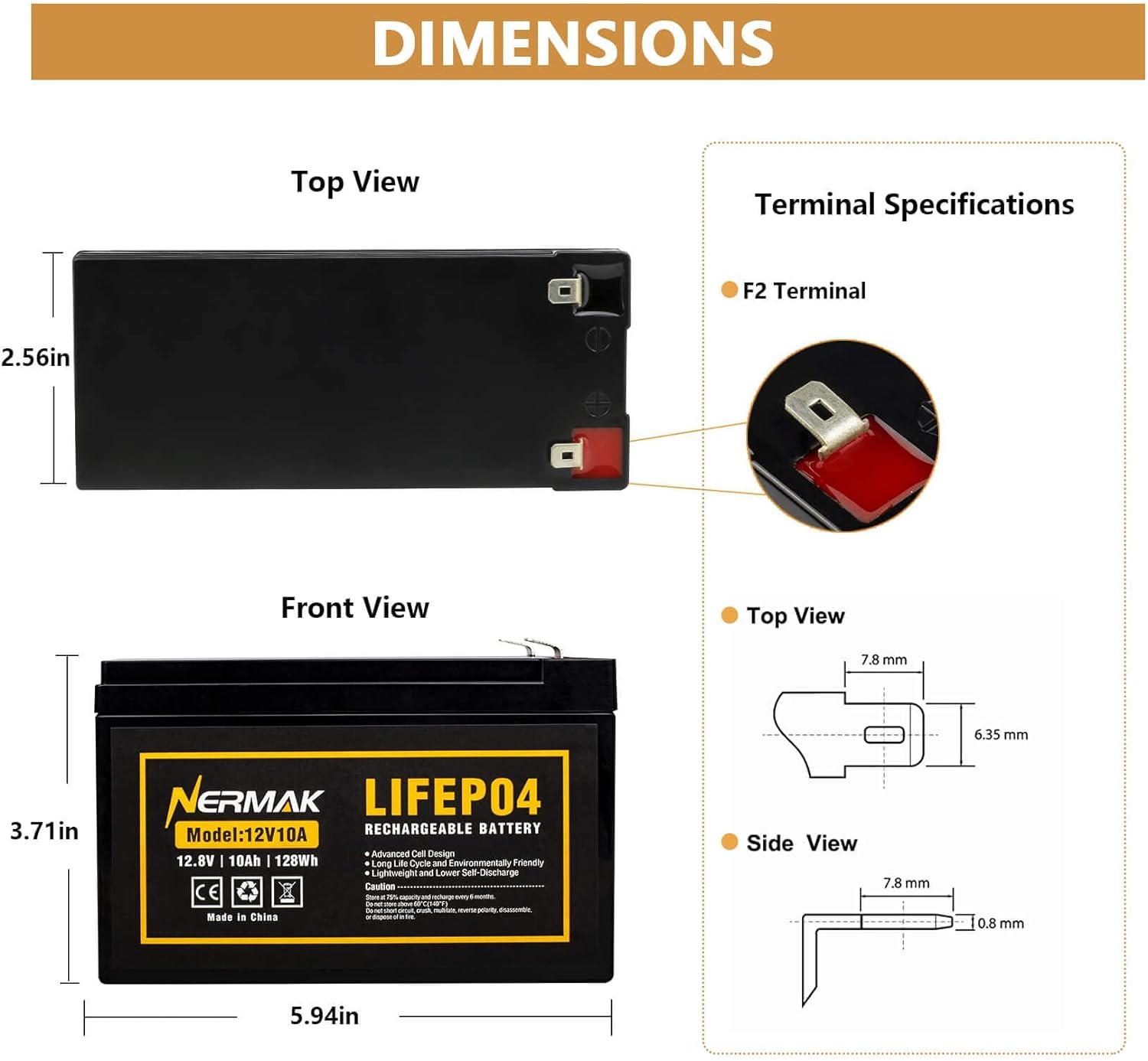
Weight and form factor At 12 Ah, a LiFePO4 pack typically weighs 3–4 lbs versus 8–10 lbs for a comparable AGM. At 20–30 Ah, you’re around 6–8 lbs LiFePO4 vs. 15–20 lbs AGM. For kayak fishing or backcountry camera work, this isn’t a footnote — it’s a load decision.
The Competitive Landscape: What’s Available and Where Brands Sit
The 12V small-format LiFePO4 market has matured considerably. A few categories are worth distinguishing:
Integrated solar + battery kits — Goal Zero’s technical documentation for their Yeti and Sherpa lines positions them as all-in-one solutions aimed at users who don’t want to assemble components. They work, but you pay a premium for the packaging and often get less raw Ah per dollar than a bare battery + separate solar panel.
Bare battery + separate charge controller — Renogy’s 12V LiFePO4 series (12 Ah, 20 Ah, 50 Ah) represents the volume middle of this market. Pairing a Renogy battery with their Wanderer or Rover MPPT charge controller is a common and well-documented setup in the overlanding and trail camera communities. Owners report reliable performance and straightforward setup. The trade-off versus all-in-one is that you’re managing two components — but you get better Ah-per-dollar and more flexibility.
Battle Born and Ampere Time occupy the premium bare-battery tier, with higher-spec BMS units and more aggressive low-temperature performance ratings. Battle Born’s 12V 30 Ah is a frequent recommendation in ham radio portable operation communities precisely because the BMS holds discharge down to -4°F — operators running winter emergency nets in cold climates consistently cite this as the deciding factor.
Unbranded / import packs (typically found in warehouse clubs or generic online retail) occupy the budget tier. Aggregated reviews show inconsistent capacity delivery and higher early-failure rates. For a trail camera on private land where you can swap batteries easily, the risk is manageable. For a camera 8 miles into wilderness, it’s a gamble not worth taking.
Decision Rules: If X, Then Y
Here’s the practical framework given everything above:
If you’re running trail cameras only, checking every 30–60 days: → A 12 Ah LiFePO4 from a named brand (Renogy, Ampere Time) with a temperature-rated BMS is your answer. Add a 10–20W solar panel if the location gets 3+ peak sun hours. Total cost: $60–$120. You don’t need anything bigger.
If you’re powering a full-featured fish finder (chartplotter + color display) for full-day trips: → Start at 20 Ah, and consider 30 Ah if you fish 10+ hours regularly. Weight savings over AGM justify the $30–60 price premium immediately. Check the BMS’s continuous discharge current rating — it needs to exceed your fish finder’s peak draw with margin.
If you’re operating ham radio HF at 100W, field portable: → Size by your actual duty cycle, not the radio’s nameplate. At 10% duty cycle with a 4-hour window, 20 Ah is serviceable. ARRL’s Emergency Communication Handbook recommends a minimum 20% safety margin on battery capacity for emergency communication deployments — build that in. If you’re running Field Day or SOTA activations at higher duty cycles or longer sessions, 50 Ah is the minimum you should consider, and weight becomes your primary constraint.
If temperature drops below freezing during your deployment: → Filter your shortlist to batteries with a BMS rated for at least -4°F (-20°C) discharge. This eliminates most budget options immediately and points toward Battle Born and Renogy’s cold-weather LiFePO4 variants. Charging LiFePO4 below 32°F damages cells regardless of BMS — if ambient temperatures fall that low, add a low-temperature charging cutoff or bring the battery inside to charge.
If this is your first LiFePO4 and you want the lowest-friction setup: → A name-brand all-in-one kit (Goal Zero’s portable power station line, for example) costs more per watt-hour but removes the “did I wire the charge controller right?” variable. For a practitioner building toward multi-unit deployments, the component route is worth learning — but there’s no shame in starting with an integrated unit and moving to bare batteries once you understand your load profile better.
The right-sizing instinct you’re building here scales directly: the same amp-hour math that governs a $80 trail camera battery governs a $15,000 whole-home battery backup calculation. Get comfortable with it at small scale, and the larger decisions get proportionally cleaner.