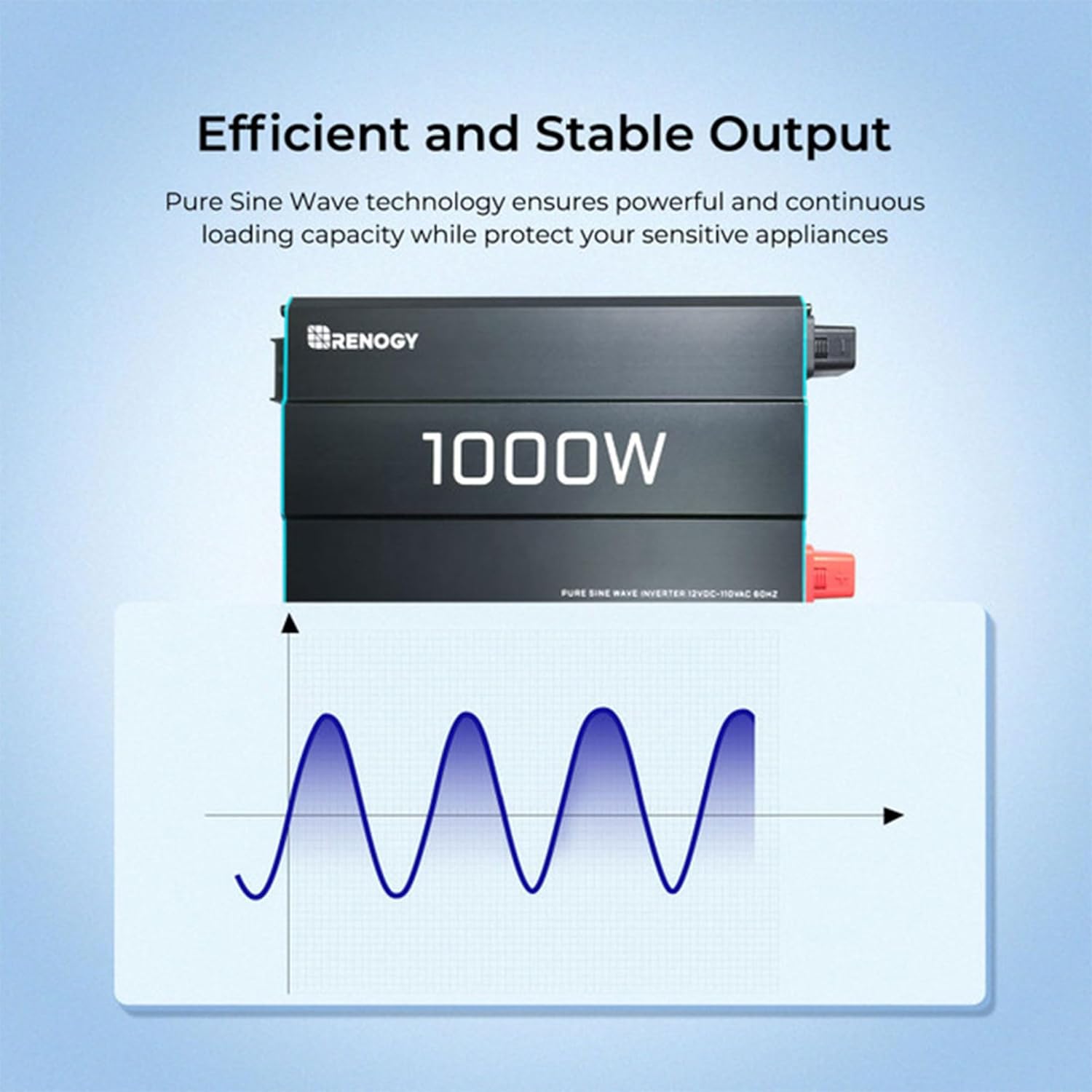
Your battery bank stores energy as DC — direct current, the same type that flows from a car battery. But most of the appliances in an RV, a cabin, or an off-grid home run on AC — alternating current, the kind that comes out of a wall outlet. An inverter is the device that bridges that gap, converting your stored DC power into usable AC power. A pure sine wave inverter specifically produces smooth, symmetrical AC power that closely mimics what the utility grid delivers — which matters because sensitive electronics like microwaves, variable-speed motors, and CPAP machines can behave erratically, run hotter, or even fail on the “modified sine wave” alternative. If you’re building a real-world off-grid or RV system today and you’ve gotten past the basics, this guide is about the decision most people get wrong: not which brand to buy, but how many watts you actually need — and why that number is almost never the one you first assume.
Why Inverter Sizing Goes Wrong (and Why It’s Costly)
The instinct is to buy big. A 3,000-watt inverter handles more than a 2,000-watt unit, so why not go larger and never worry about it? Here’s the problem: inverters operate most efficiently — typically 90–95% efficiency — when loaded to roughly 50–80% of their rated capacity, per published spec sheets from Victron Energy and Renogy’s technical documentation. Run a 3,000W inverter at a consistent 300W load (10% utilization) and you’re burning disproportionate standby power and paying for hardware you never use. For a full-time liveaboard or an off-grid cabin where every amp-hour matters, chronic under-loading is a real operating cost.
The flip side is equally damaging. Under-size your inverter and you’ll trip the overload protection the first time you run a microwave and a water pump simultaneously — a scenario so common that forum moderators on RV communities flag it as the single most-reported commissioning failure, a pattern noted in Solar Power World’s coverage of off-grid installer field reports.
The fix is a load list. Not a guess, and not the nameplate wattage on every device — a real load list that accounts for surge, duty cycle, and simultaneous use.
Building Your Real Load List: The Three Numbers That Matter
Every appliance has three numbers you need:
- Running watts — the steady-state power draw while the device is operating normally.
- Surge watts (inrush current) — the brief spike, typically 1.5× to 3× running watts, that motors and compressors demand at startup. A 700W refrigerator compressor, for example, commonly surges to 1,400–2,100W for 1–3 seconds at startup, per Renogy’s appliance load reference guide.
- Duty cycle — what fraction of an hour the device actually runs. A refrigerator rated at 150W running watts might cycle on for 20 minutes per hour, giving you an effective draw of 50Wh per hour, not 150Wh.
A Worked Example: Midsize RV Build
Here’s a representative load list for a 30-foot RV with a 200Ah lithium battery bank:
| Appliance | Running Watts | Surge Watts | Hours/Day | Daily Wh |
|---|---|---|---|---|
| Residential refrigerator | 150W | 1,800W | 8 (cycling) | 1,200Wh |
| Microwave (900W unit) | 1,000W | 1,200W | 0.25 | 250Wh |
| Laptop + monitor | 120W | 130W | 6 | 720Wh |
| LED lighting | 60W | 60W | 5 | 300Wh |
| Phone/device charging | 40W | 40W | 3 | 120Wh |
| Water pump (12V, bypasses inverter) | — | — | — | — |
| Totals | ~1,370W peak simultaneous | ~3,180W surge | — | 2,590Wh |
By the numbers:
- Peak simultaneous running load: ~1,370W
- Worst-case surge (refrigerator startup during microwave use): ~2,970W
- Daily energy budget: ~2,590Wh
- Recommended inverter: 2,000–2,500W continuous, with ≥3,000W surge rating
The surge column is doing the real work here. An inverter rated “2,000W continuous / 4,000W surge” — a common spec tier from manufacturers like Victron, Renogy, and Aims Power — handles this load list with headroom. A 1,500W unit with a 3,000W surge rating would survive, but you’d be running it close to its edge on any simultaneous load scenario, a pattern NREL’s inverter controls research identifies as a leading cause of premature thermal degradation in residential-scale units.
Pure Sine Wave vs. Modified Sine Wave: When the Difference Actually Matters
You’ll still encounter modified sine wave (MSW) inverters at lower price points — typically $80–$200 for 1,000–1,500W units. For resistive loads (incandescent bulbs, simple heating elements, basic battery chargers), MSW is functionally acceptable. The tradeoffs emerge with:
- Variable-speed motors in refrigerators and CPAP machines — they run hotter, louder, and shorter-lived on MSW
- Newer laptop and phone chargers (switch-mode power supplies) — many tolerate MSW but some generate audible hum or run inefficiently
- Medical devices — CPAP manufacturers including ResMed and Philips Respironics explicitly recommend pure sine wave in their device documentation
- LED dimmers and smart home devices — MSW produces flicker and erratic behavior
EnergySage’s off-grid buying guidance notes that as system sizes grow past 1,000Wh of daily consumption, the operational friction of MSW — shorter appliance lifespans, workarounds, component replacements — typically outweighs the upfront cost savings within two to three years of use.
For any build intended as a primary residence substitute (full-time RV, off-grid cabin, van conversion with real appliances), pure sine wave is the practical baseline, not a luxury upgrade.
Matching Inverter Size to System Voltage: The 12V vs. 24V vs. 48V Decision
This is the decision point many intermediate builders underestimate. Inverter continuous wattage and system voltage are directly linked through wire sizing and efficiency:
- 12V systems: Practical ceiling is roughly 2,000–2,500W continuous. Beyond that, the DC wire runs required to deliver the current (200+ amps at 12V for a 2,400W load) become expensive, lossy, and physically unwieldy.
- 24V systems: Extend the practical ceiling to 3,000–4,000W, halve the current draw for the same wattage, and allow meaningfully smaller wire gauges.
- 48V systems: The standard for serious off-grid installs and increasingly common in prosumer RV builds using LiFePO4 battery banks. Supports 5,000W+ inverters with manageable wire runs and aligns with the battery chemistry now dominant at the 100Ah+ tier.
Victron’s MultiPlus and Quattro lines — widely referenced in off-grid installer specifications — are available across all three voltage tiers precisely because this decision is system-specific, not product-specific. The U.S. Department of Energy’s energy storage guidance echoes that system voltage selection should precede inverter selection in any build workflow, not follow it.
If your load list peaks below 1,500W and your battery bank is under 200Ah, a 12V system is simpler and cheaper to wire. If you’re building toward whole-cabin loads — full-size refrigerator, air conditioning circuits, workshop tools — start at 48V.
The Efficiency Curve: Where Inverters Actually Lose Power
Manufacturer-rated peak efficiency (often 93–97%) is a marketing number measured at optimal load. The operating efficiency curve — how the unit performs across the full range of loads — is what matters for daily energy budgeting.
Most pure sine wave inverters hit their peak efficiency at 50–75% of rated continuous load, then drop off at both extremes:
- At very low loads (under 10%), standby and quiescent current consumption become the dominant factor. A 3,000W inverter drawing 15–25W of standby power while you’re only running a 60W lamp is wasting 20–40% of the lamp’s energy budget in overhead.
- At loads above 85% of rated, thermal management systems engage and efficiency drops modestly, typically 2–4 points.
The practical implication: right-size your inverter so your average operating load falls in the 40–70% range. For the example RV load list above (average ~600W across a 24-hour day), a 1,500W inverter would run at 40% average utilization — well-optimized. A 3,000W unit would average 20% — marginal.
Some builders solve this with a dual-inverter setup: a small 300–600W inverter running continuously for baseline loads (lighting, device charging, refrigerator overnight), with a larger 2,000–3,000W unit switched in for microwave and high-draw events. Victron’s documentation on MultiPlus “assistant” programming explicitly supports this configuration, and several off-grid installers profiled in Solar Power World have documented 15–20% reductions in daily inverter losses using this approach.
What the Market Looks Like in Mid-2026
The pure sine wave inverter market at the 1,000–5,000W tier has consolidated meaningfully. A few reference points based on published distributor pricing and manufacturer spec sheets as of Q2 2026:
- Entry prosumer (1,000–2,000W, 12V PSW): $150–$400. Renogy and AIMS Power occupy this band with units targeting van conversions and smaller RV builds.
- Mid-tier (2,000–3,000W, 12V or 24V PSW): $300–$700. Increasing competition from Chinese OEM brands with UL certification has compressed margins here.
- Serious off-grid / inverter-charger combos (2,000–5,000W, 24V or 48V): $600–$2,000+. Victron MultiPlus, Schneider Electric XW+, and Outback Radian dominate specifications in installer-designed systems. These units integrate AC charging from generator or shore power, which standalone inverters don’t.
- Lithium-native all-in-one units (inverter + MPPT charge controller + battery management in one enclosure): The fastest-growing segment in 2025–2026, led by EcoFlow and Bluetti at the portable end and Victron/Growatt hybrids at the fixed-installation end.
The Decision Rule: If X, Then Y
If your peak simultaneous load is under 1,500W and your battery bank is 12V: a 2,000W pure sine wave inverter at 12V covers your surge headroom without over-building.
If your peak simultaneous load is 1,500–3,000W, or you’re running any compressor loads: move to 24V system architecture and a 3,000W PSW inverter with at least 6,000W surge rating.
If you’re building a full cabin or serious full-time RV with air conditioning: 48V is the correct system voltage, an inverter-charger (not a standalone inverter) is the correct product category, and your sizing floor is 3,500W continuous.
If your daily energy budget is under 1,000Wh and your loads are modest: don’t over-size. A 1,500W pure sine wave inverter running at healthy utilization will outlast and outperform a 3,000W unit running at 15% load.
The load list is the document. Everything else — brand, form factor, warranty depth — is secondary to getting the wattage architecture right before you buy. Build the spreadsheet first, then shop.