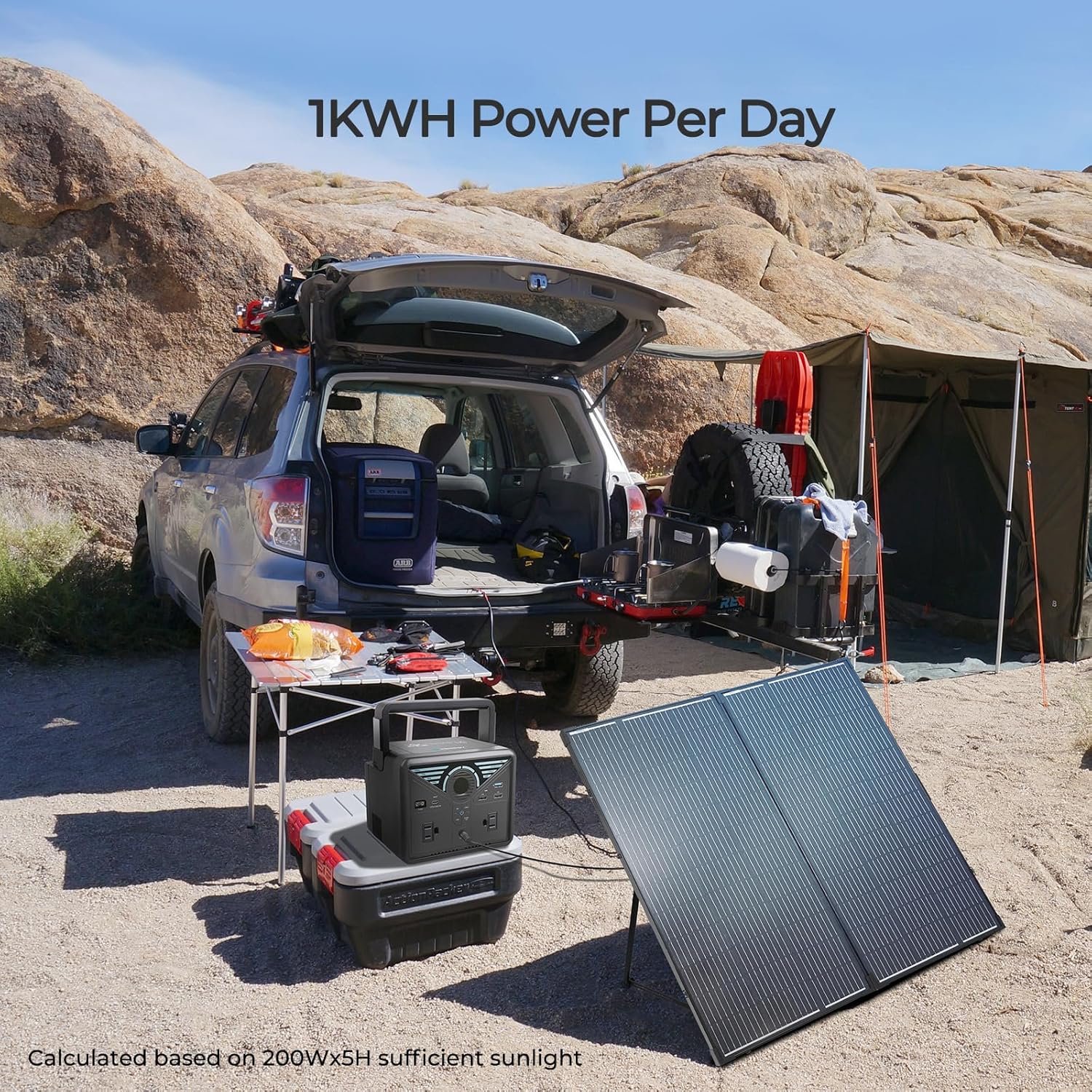
You’ve probably noticed that the watt rating printed on a foldable solar panel — the number in big bold type on the box — never quite matches what you see in real life. A “100W” panel is a measurement of peak output under a very specific set of laboratory conditions: full, direct sunlight at a precise angle, at a particular temperature, with no clouds or dust anywhere in the picture. Those conditions are called Standard Test Conditions (STC), and they exist so manufacturers can compare panels on an apples-to-apples basis. The problem is that your campsite, van roof, or balcony railing doesn’t look much like a laboratory. In practice, that same 100W panel might deliver 55–75 watts on a warm, partly cloudy afternoon — which changes your charging math considerably. This article walks through the real derating factors (the reasons output drops from the nameplate number), shows you the calculation you need to estimate actual daily energy harvest, and gives you a clear decision rule for matching panel size to the loads you’re trying to power.
| EDITOR'S PICK[Renogy 200W Portable Solar Panel](https://www.amazon.com/dp/B0CNPHD4VY?tag=greenflower20-20) | Mid-tier200W Portable Solar Panel for P… | Budget pick[DOKIO 150W Portable Foldable So…](https://www.amazon.com/dp/B07WX6L3V6?tag=greenflower20-20) | |
|---|---|---|---|
| Wattage (rated) | 200W | 200W | 150W |
| Efficiency | 25% | — | — |
| Weight | — | — | 7.3 lb |
| Cell type | N-type | — | Monocrystalline |
| Controller included | ✓ | — | ✓ |
| Waterproof rating | — | IP65 | — |
| Price | $271.99 | $142.46 | $76.29 |
| See on Amazon → | See on Amazon → | See on Amazon → |
Why the Nameplate Watt Rating Is a Starting Point, Not a Promise
The STC rating is measured at 1,000 watts of solar irradiance per square meter (roughly what you’d see at solar noon on a clear midsummer day at sea level), a cell temperature of 25°C (77°F), and a specific light spectrum. Real deployments almost never hit all three simultaneously.
Cell temperature is the most underestimated derating factor. Solar cells lose efficiency as they heat up — typically 0.3%–0.5% per degree Celsius above 25°C, depending on cell technology. Monocrystalline PERC cells, which dominate the portable panel market from brands like Renogy and Goal Zero, run at the better end of that range. A black-backed foldable panel lying flat on a hot surface on an 85°F (29°C) day can see cell temperatures of 55–65°C — that’s a 9–15% output loss from temperature alone, before you account for anything else.
Per the U.S. Department of Energy’s Office of Energy Efficiency and Renewable Energy guidance on solar performance, temperature derating is one of the most commonly overlooked variables in consumer-level sizing calculations, even though the coefficient is published on every reputable panel’s spec sheet.
Angle and orientation losses compound quickly. A panel flat on a picnic table instead of tilted toward the sun at the optimal angle can lose 10–25% of potential output. Foldable panels are often deployed horizontally for convenience — reasonable, but it costs you real watt-hours.
Partial shading is disproportionately punishing. Unlike a fixed rooftop array with microinverters, most portable panels feed a single charge controller through a series-wired or parallel-wired string. A shadow across even 15% of the panel surface can cut output by 40–60% depending on cell layout. PV Magazine’s 2024 analysis of real-world output losses in portable photovoltaic systems found shading losses in typical van and overland use to be the single largest contributor to the gap between rated and delivered watt-hours.
Charge controller efficiency takes another cut. PWM (Pulse Width Modulation) controllers — still bundled with many entry-level kits — operate at 70–80% efficiency under typical conditions. MPPT (Maximum Power Point Tracking) controllers extract 93–97% of available panel power by continuously optimizing the voltage-current relationship. If you’re running a 100W panel through a PWM controller, you may be delivering only 70–76 usable watts even before temperature and angle losses.
The Real-World Output Formula: Show Your Work
Here’s a working framework. It’s not a precise simulation — that would require site-specific irradiance data — but it gives you a defensible planning number.
Step 1: Find your peak sun hours (PSH). This is the number of hours per day that solar irradiance averages 1,000 W/m² equivalent. It’s location- and season-specific. EnergySage’s portable solar overview cites a practical range of 3.5–6.5 PSH for the continental U.S., with the Southwest averaging 5–6.5 and the Pacific Northwest dropping to 3–4 in winter. The National Renewable Energy Laboratory’s PVWatts tool (available at nrel.gov) gives you site-specific PSH for any U.S. address.
Step 2: Apply a system efficiency multiplier. Stack your derating factors:
| Factor | Typical Loss |
|---|---|
| Cell temperature (warm day, direct sun) | 8–12% |
| Angle / orientation (non-optimal placement) | 10–20% |
| Partial shading (trees, structures) | 0–40% |
| MPPT controller efficiency | 3–7% |
| Wiring and connector losses | 1–3% |
| Combined realistic efficiency | ~65–75% of STC |
A reasonable planning multiplier for an MPPT-equipped system in unobstructed sun is 0.72. For a PWM system with typical placement, use 0.58–0.62.
Step 3: Calculate daily watt-hours.
Daily Wh = Panel Wattage × PSH × System Efficiency Multiplier
Example: 200W foldable panel, MPPT controller, 5 PSH location, 0.72 multiplier.
200W × 5h × 0.72 = 720 Wh/day
That’s enough to run a 12V compressor refrigerator drawing ~40Wh/hr for about 18 hours, or charge a 100Ah lithium battery (roughly 1,200Wh usable at 12V) just over halfway in a single day.
By the numbers:
- 100W panel, PWM, 4 PSH: ~240 Wh/day
- 100W panel, MPPT, 5 PSH: ~360 Wh/day
- 200W panel, MPPT, 5 PSH: ~720 Wh/day
- 400W panel array, MPPT, 5.5 PSH: ~1,584 Wh/day
That 50% spread between a 100W panel with a PWM controller and a 100W panel with an MPPT controller — at the same location — is why controller choice matters almost as much as panel wattage in the under-400W portable segment.
Monocrystalline vs. Bifacial Portable Panels: Which Tech Actually Helps
The market for foldable panels in 2026 has largely consolidated around monocrystalline PERC cells at 20–23% efficiency for the mainstream segment. That efficiency figure from NREL’s Best Research-Cell Efficiency Chart represents the percentage of sunlight hitting the cell surface that gets converted to electricity — higher is better, and it directly determines how much panel area you need for a given wattage.
A 100W panel at 21% efficiency requires roughly 0.48 m² of cell area. At 17% efficiency (older polycrystalline technology, still found in clearance inventory), the same 100W needs about 0.59 m² — a 23% larger footprint. For portable use, efficiency translates directly to pack size and weight.
Bifacial cells — which capture reflected light from below the panel as well as direct light from above — are beginning to appear in the prosumer portable segment. Bifacial gain in the field depends heavily on the ground surface below the panel: a white or reflective surface can add 5–15% output; dirt or dark pavement contributes almost nothing. Solar Power World’s 2025 coverage of portable bifacial deployments notes that bifacial gain is “highly context-dependent and frequently overstated in marketing materials targeting mobile users.” Unless you’re deploying on a bright surface with the panel elevated, bifacial isn’t worth a premium for most foldable use cases.
Flexible vs. rigid-framed foldable panels represent a different tradeoff. Flexible panels conform to curved surfaces and weigh less, but they sacrifice 1–3 percentage points of cell efficiency and degrade faster under repeated flexing stress. For van rooftops where permanent adhesion is desired, flexible can make sense. For kit-based charging where you’re setting up and breaking down daily, a rigid-framed foldable panel with carry handles survives the duty cycle better, as consistently noted by long-run reviewers on platforms like EnergySage’s user forums and across aggregated reviews on specialty RV and overlanding communities.
Matching Panel Size to Your Actual Loads
This is where practitioner-level buyers tend to get it right or get it wrong. The sizing error pattern is almost always under-specification — buyers anchor on panel wattage and forget that storage (battery) capacity is the buffer that makes the system functional across variable sun days.
The quick load audit: List every device you need to power, its wattage, and its daily hours of use. Multiply to get watt-hours per device, sum them up. That’s your daily energy demand. Add 20% for inefficiency and unexpected loads.
Common loads in a portable solar context:
- 12V compressor fridge (40L): 40–60 Wh/hr, runs ~50% of the time = 480–720 Wh/day
- Laptop charging: 65W × 3 hours = ~195 Wh/day
- Phone/tablet charging (×2): ~30 Wh/day
- LED lighting: 15W × 4 hours = 60 Wh/day
- Realistic daily total: 765–1,005 Wh/day for a well-equipped van or overlanding setup
At 720 Wh/day from a 200W MPPT system in a 5 PSH environment, you’re just under that demand — which means a single cloudy day draws down your battery reserve. The practical answer is either a second 100W panel to create a 300W array, a larger battery bank (100Ah lithium is a minimum; 200Ah is more comfortable), or both.
If X, then Y — the decision rules:
- If your daily load is under 400 Wh and you have 5+ PSH: a single 100W MPPT kit (Renogy, Goal Zero, or equivalent) covers it with margin. Don’t overspend on 200W.
- If your daily load is 400–800 Wh: size for a 200W panel with an MPPT controller and at least a 100Ah lithium battery. PWM controllers leave too much energy on the table at this scale.
- If your daily load exceeds 800 Wh or you’re in a 3–4 PSH climate: plan for 300–400W of panel capacity, a 200Ah+ battery bank, and accept that you may need shore power or a generator on consecutive cloudy days. No foldable kit reliably covers high-consumption setups in low-sun environments without storage depth.
- If you’re comparing two panels with the same wattage rating: check the temperature coefficient and efficiency percentage on the spec sheet, not just the headline watt number. A 100W panel at 22% efficiency in 85°F weather outperforms a 100W panel at 18% efficiency — meaningfully, over the course of a week.
The watt rating gets you in the door. The derating math tells you what you’ll actually live with.