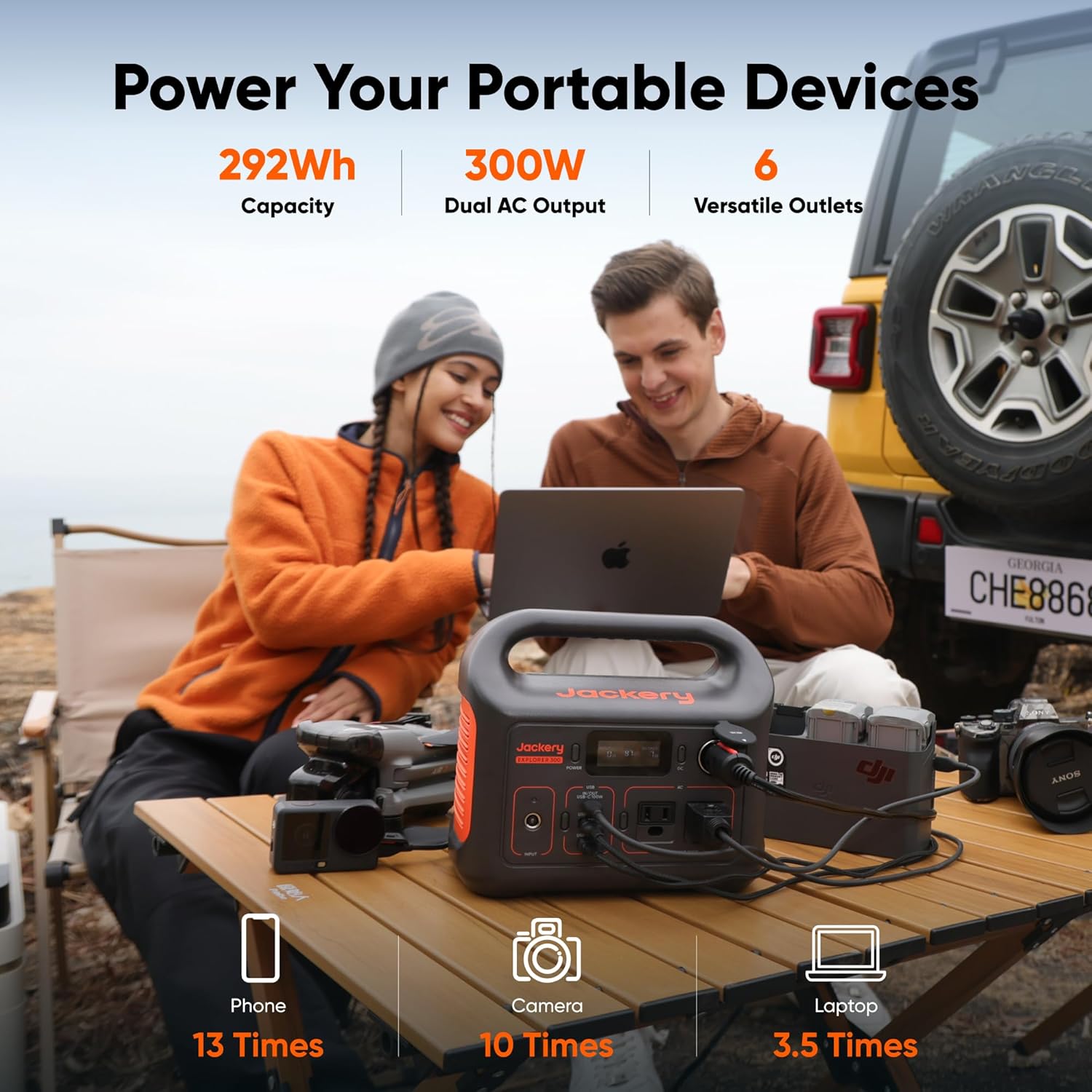
A portable power station is essentially a large rechargeable battery in a box — it stores electricity ahead of time so that when your utility grid goes down, you can keep lights on, charge phones, run a medical device, or power a refrigerator without a noisy gas generator. The core spec that determines how long it can do all of that is watt-hours (Wh): one watt-hour is enough energy to run a one-watt device for one hour. A 1,000 Wh station can, in theory, power a 100-watt appliance for ten hours. The catch — and the reason most people buy too small or overspend — is that real outage loads rarely look like the tidy math on the product page. This guide walks you through calculating your actual needs, translating that into a capacity target, and mapping that target onto the models available in 2026.
| EDITOR'S PICK[EF ECOFLOW Portable Power Stati…](https://www.amazon.com/dp/B09PBMZ5WT?tag=greenflower20-20) | Mid-tierEF ECOFLOW Portable Power Stati… | Budget pick[Jackery Portable Power Station…](https://www.amazon.com/dp/B0DFGLG35L?tag=greenflower20-20) | |
|---|---|---|---|
| Capacity | 3600Wh | 1024Wh | 292Wh |
| Output power | 3600W | 1800W | — |
| AC outlets | 5 | — | — |
| Charge time | 2.7H | — | — |
| Price | $1,479.00 | $398.99 | $188.99 |
| See on Amazon → | See on Amazon → | See on Amazon → |
Why the “1,000 Wh Is Plenty” Rule Fails in Practice
The single biggest sizing mistake is anchoring on a round number rather than modeling a real outage scenario. Here is why the math goes sideways.
Runtime is not linear. Portable power stations lose efficiency under heavy load. A 2,000 Wh unit running at 80% of its rated continuous wattage will deliver meaningfully fewer usable watt-hours than the spec sheet implies, because lithium iron phosphate (LFP) and lithium nickel manganese cobalt (NMC) chemistries both experience efficiency losses and internal heating under sustained high draw. Consumer Reports’ 2025 evaluation of portable stations notes that real-world usable capacity typically lands 10–20% below nameplate, depending on load profile and ambient temperature.
Surge wattage matters more than running wattage. Most motors — refrigerators, sump pumps, window AC units — draw two to three times their steady-state wattage for the first few seconds at startup. This is called the surge or peak draw. If your station’s inverter (the component that converts stored DC battery power to the AC power your outlets deliver) can’t handle that surge, it will shut down or trip a protection circuit. Running wattage tells you how long the unit lasts; surge wattage tells you whether it can start the appliance at all.
Depth of discharge limits usable capacity. Most manufacturers recommend not drawing a lithium battery below 20% state of charge to protect cycle life. That means a nominally 1,500 Wh station has roughly 1,200 Wh of recommended usable capacity. EnergySage’s portable power station buyer’s guide flags this as one of the most misunderstood specs in the category.
Build Your Outage Load List Before You Look at a Single Product
Sizing starts with a load audit, not a product page. The process takes under 30 minutes.
Step 1 — Identify your critical loads. Divide your home appliances into three tiers:
- Must-have: medical devices (CPAP machines, home oxygen concentrators), refrigerator/freezer, basic lighting, phone and laptop charging.
- Important: sump pump (in flood-prone basements), router/modem for remote work.
- Nice-to-have: window AC, electric kettle, TV.
Start with must-have only. Add tiers only after confirming your capacity target is affordable.
Step 2 — Find running watts and surge watts for each appliance. The appliance nameplate, the manufacturer spec sheet, or the U.S. Department of Energy’s appliance energy use reference tables are your best sources. EnergySage’s buyer’s guide includes a consolidated table of common household appliances and their typical running wattages.
Step 3 — Estimate daily runtime per appliance. A refrigerator doesn’t draw its rated wattage continuously — the compressor cycles on and off. In practice, a 150-watt-rated fridge typically runs the compressor about 30–40% of the time, so its effective hourly draw averages closer to 50–60 watts. Your CPAP at 30–50 watts runs 8 hours a night. Your phone charger at 20 watts runs maybe 2 hours. Add it up per 24-hour outage period.
Step 4 — Multiply running watts × hours, then add 20% buffer. That gives you a daily watt-hour target. For a 48-hour outage, double it (or plan to solar-recharge mid-outage — more on that below).
By the Numbers: A Realistic Two-Day Critical-Load Scenario
| Appliance | Running Watts | Daily Hours Active | Daily Wh |
|---|---|---|---|
| Refrigerator (cycling) | ~55 W effective | 24 h | 1,320 Wh |
| CPAP (no humidifier) | 30 W | 8 h | 240 Wh |
| LED lighting (4 bulbs) | 40 W | 6 h | 240 Wh |
| Phone + laptop charging | 65 W | 3 h | 195 Wh |
| Daily total | 1,995 Wh | ||
| 48-hour total + 20% buffer | ~4,800 Wh |
That number surprises most buyers who assumed a 1,500 Wh station would cover a weekend outage. It won’t — not for this load set.
Matching Capacity Targets to Product Tiers
With a watt-hour target in hand, here is how the current market segments shake out as of mid-2026.
Under 1,000 Wh — Phone and light duty only. Units from Goal Zero (Yeti 500X, Yeti 1000 Core) and Jackery (Explorer 300 Plus, Explorer 1000 v2) spec out well for camping and device charging, but they are not home backup solutions for anything with a compressor or motor. PV Magazine’s Q1 2026 portable storage pricing roundup pegs this segment at roughly $0.40–$0.65 per watt-hour, making them good entry-point purchases but not the right tool for a refrigerator.
1,000–2,000 Wh — Marginal for critical home loads. This is the most-purchased segment and the most commonly undersized. Renogy’s Lycan 5000 Power Box, EcoFlow’s Delta 2 Max (2,048 Wh), and Bluetti’s AC200L (2,048 Wh) can run a fridge for roughly 18–24 hours under real-world conditions. They are viable for short outages (under 24 hours) with disciplined load management, but fall short of a 48-hour critical-load scenario without solar recharging during the outage.
2,000–3,600 Wh — The practical sweet spot for most homeowners. The EcoFlow Delta Pro (3,600 Wh expandable), Jackery Explorer 3000 Pro, and Bluetti AC300+B300 systems enter the range where a single unit can realistically carry the load scenario in the table above through one day, with solar top-up extending coverage meaningfully. NREL’s 2024 residential battery cost analysis notes that portable LFP units in this capacity band have seen cost declines of roughly 18% year-over-year through 2025, making the $1,200–$2,200 price range increasingly competitive against whole-home battery installs for renters or situations requiring portability.
3,600 Wh and above — Expandable ecosystems. Units like the EcoFlow Delta Pro Ultra (expandable to 21.6 kWh with battery modules) and Bluetti EP900+B500 systems blur the line between portable station and semi-permanent home battery backup. Owners in aggregated reviews consistently highlight the expandable architecture as the key differentiator — you buy a base unit now and add capacity as budget allows. The tradeoff is weight (these units are not truly portable in the “carry to your car” sense) and upfront cost, which approaches installed battery backup territory.
The Solar Recharge Variable Changes Everything
If your outage lasts more than 24 hours, solar recharging turns a marginal system into a viable one. Every major portable station now ships with an MPPT charge controller (a component that optimizes power harvest from solar panels), and manufacturers publish maximum solar input wattage.
A 400W solar input rating means, under ideal conditions (full sun, optimal panel angle), you can add roughly 1,600–2,000 Wh per day of recharging. In practice, consumer solar panel output drops 20–40% in partly cloudy conditions, and most residential installs don’t achieve peak-angle optimization. Budget 50–60% of rated input as a conservative daily recharge estimate.
That math matters: if your daily draw is 2,000 Wh and your solar system adds back 1,200 Wh per day, your net daily draw on the battery is only 800 Wh — and a 2,000 Wh station suddenly has 2.5 days of realistic autonomy instead of one. EnergySage’s buyer’s guide models exactly this scenario and recommends pairing a 2,000 Wh station with at least 400W of portable solar panels for any outage scenario beyond 24 hours.
If X, Then Y: The Decision Rules
You’ve done the load math. Here is how to translate it into a purchase frame.
If your outage history is < 12 hours and your critical loads are devices + lighting only → A 1,000–1,500 Wh unit (EcoFlow Delta 2, Jackery Explorer 1000 v2 class) is sufficient. Don’t overspend.
If you need to run a refrigerator through a 24-hour outage → Target 2,000–2,500 Wh with at least 300W solar input capability. The EcoFlow Delta 2 Max or Bluetti AC200L class hits this threshold. Add a 200W portable solar panel for margin.
If your scenario is 48+ hours, includes a sump pump or CPAP, and you’re in a region with repeat multi-day outages → Target 3,500+ Wh with expandable capacity. Budget $1,800–$3,000 for the base unit. Pair with 400W+ solar input. The EcoFlow Delta Pro or Bluetti AC300+B300 class is the minimum; the expandable ultra-capacity systems are worth serious consideration if you’re not ready for a full installed battery system.
If you’re a renter or need true portability → LFP chemistry (lithium iron phosphate, used in Bluetti and EcoFlow’s current-generation units) offers better cycle life (3,000–3,500 cycles to 80% capacity versus 500–800 for older NMC units, per manufacturer-published spec sheets) and better thermal stability. Pay the small premium for LFP if you’re treating this as a 5–10 year asset.
If your load audit puts you above 5,000 Wh daily → You’ve outgrown the portable station category. You’re in installed battery backup territory — a Powerwall 3 or Enphase IQ Battery 5P system with a transfer switch is the appropriate solution. Consumer Reports’ 2025 coverage of home backup explicitly positions the 5+ kWh daily demand threshold as the crossover point where installation costs amortize favorably against stacking multiple portable units.
One last thing: the spec sheet is your baseline, not your guarantee. Cross-reference manufacturer-rated capacity against owner reviews on the platforms where your target model has the most volume, look for patterns in temperature performance and inverter surge behavior, and verify the unit’s continuous AC output rating against your highest-surge appliance before you commit. The math is straightforward — the discipline is doing it before you’re standing in the dark.