Every solar panel array needs a gatekeeper between the panels and your batteries — a device that takes the raw electricity your panels generate and conditions it into a safe, controlled charge that won’t cook your battery bank. That gatekeeper is called a charge controller. Think of it as a traffic signal managing the flow of energy: without it, panels would push unregulated current into your batteries and shorten their life dramatically. There are two fundamentally different technologies for doing this job — PWM (Pulse Width Modulation) and MPPT (Maximum Power Point Tracking) — and picking the wrong one for your installation is one of the most common ways solar buyers leave money and efficiency on the table. This guide breaks down exactly how each works, where each wins, and gives you a clear decision rule so you can stop second-guessing and close out that spec sheet.
| EDITOR'S PICK[Renogy Solar Charge Controller…](https://www.amazon.com/dp/B01MSYGZGI?tag=greenflower20-20) | Mid-tier[Victron Energy SmartSolar MPPT…](https://www.amazon.com/dp/B073ZJ43L1?tag=greenflower20-20) | Budget pick[Victron Energy SmartSolar MPPT…](https://www.amazon.com/dp/B073ZJ3L13?tag=greenflower20-20) | |
|---|---|---|---|
| Max Input Volts | — | 100V | 100V |
| Max Amp Rating | 40A | 50A | 30A |
| Bluetooth | ✗ | ✓ | ✓ |
| LCD Display | ✓ | — | — |
| Price | $157.35 | $155.04 | |
| See on Amazon → | See on Amazon → | See on Amazon → |
How Each Technology Actually Works (And Why It Matters)
PWM: Simple, Direct, Proven
A PWM controller connects your solar panels directly to your battery bank and regulates charging by rapidly switching the current on and off — pulsing it — as the battery approaches full charge. The “pulse width” narrows as charge level rises, tapering current smoothly without overvoltage.
The consequence of that direct connection is the key constraint: your panel array’s voltage must be matched closely to your battery bank’s voltage. A 12V battery system needs panels wired to output roughly 12–18V. If your panel’s Vmp (voltage at maximum power) is substantially higher than your battery voltage, a PWM controller simply bleeds off that excess voltage as wasted heat rather than converting it into usable current. You are leaving power on the table.
The U.S. Department of Energy’s Solar Energy Technologies Office, in its off-grid solar systems primer, identifies PWM controllers as well-suited for small, matched-voltage systems where simplicity and upfront cost are the priority. They have been the workhorse of portable and entry-level off-grid solar for decades, and for legitimate reasons: fewer components, lower failure points, and a price point that makes sense for systems modest enough that the efficiency gap does not translate to meaningful lost revenue or generator runtime.
MPPT: The Efficiency Engine
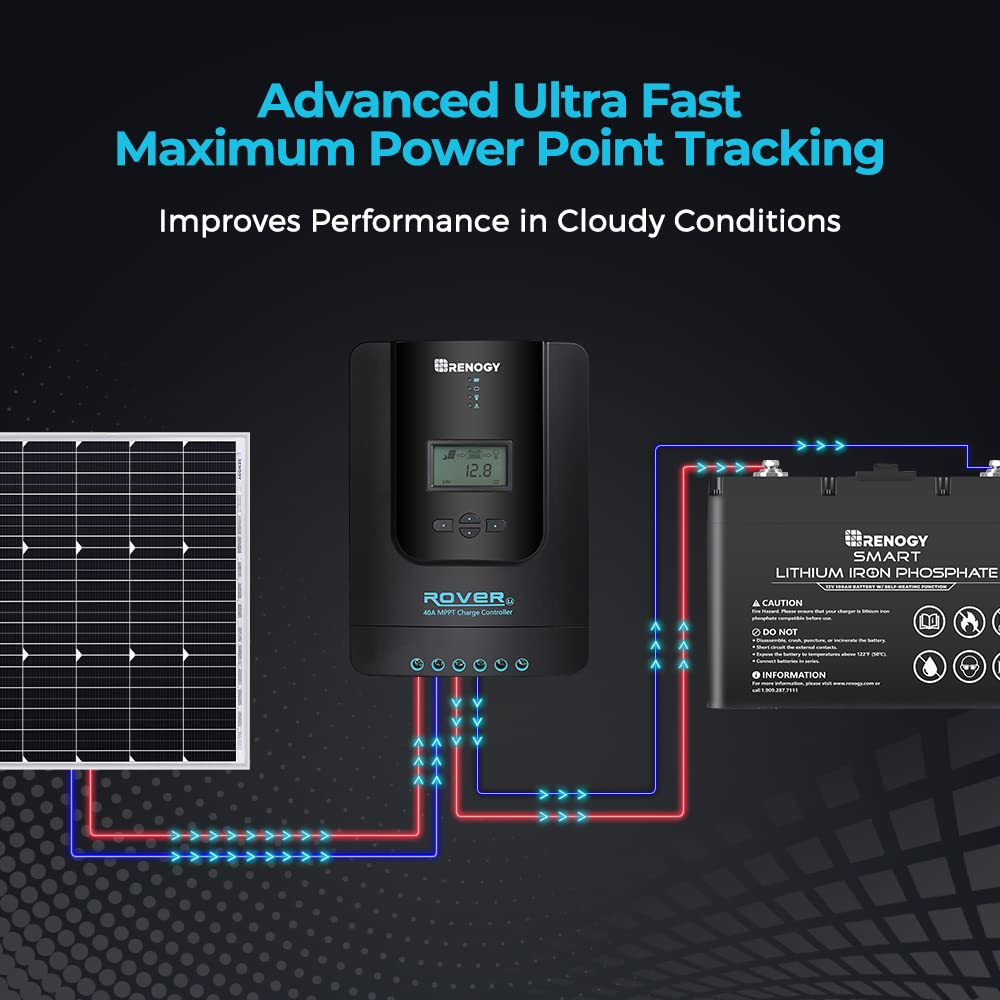
An MPPT controller adds a DC-to-DC conversion stage — essentially a sophisticated power converter — that electronically hunts for the voltage and current combination at which your panel array is producing its absolute peak power output at any given moment (the “maximum power point”). It then steps that voltage down to what your battery needs, converting the excess voltage into additional current rather than heat.
The practical effect: you can run a higher-voltage panel array — say, two 24V panels in series producing 48V — into a 12V battery bank, and the MPPT controller harvests power from that voltage differential instead of discarding it. In real-world conditions with temperature swings and partial shading, the MPPT’s tracking algorithm continuously recalculates that optimal operating point. PV Magazine’s technical reporting on MPPT performance under partial shading conditions has noted that active power point tracking can recover meaningfully more usable energy than a fixed-voltage approach during non-ideal conditions — a category that describes most real installations most of the time.
National Renewable Energy Laboratory technical reporting on charge controller technology notes that MPPT efficiency ratings — the percentage of available panel power that actually reaches the battery — typically range from 93% to 99% for quality units, compared to substantially lower effective efficiency for PWM under mismatched-voltage conditions. The gap is not a marketing claim; it is a direct consequence of whether the controller can utilize or must discard the voltage differential between the panel string and the battery bank.
The Decision Variables: Where Each Controller Wins
This is not a case where one technology is universally better. It is a case where the right answer depends tightly on four variables: system size, panel-to-battery voltage relationship, climate, and budget.
### System Voltage Match
This is the single most important factor. If your panel array’s Vmp is within about 5V of your battery bank’s nominal voltage, PWM loses very little. A classic example: a single 100W 12V panel (Vmp roughly 18V) charging a 12V lithium battery through a PWM controller. The voltage gap is manageable, and the efficiency penalty is modest.
The moment you start combining panels in series to reach higher voltages — because your wire run is long and you want to reduce current and resistive losses, or because your panels are simply higher-voltage 60-cell or 72-cell modules — the math flips hard in MPPT’s favor. A 24V panel array feeding a 12V battery bank through a PWM controller operates at roughly 50% theoretical conversion efficiency on the voltage step-down alone. That is not a rounding error; that is half your potential energy thrown away.

Victron
In stock on Amazon
Check price on Amazon### System Scale and Cost Crossover
EnergySage’s solar charge controller analysis identifies the practical break-even point for MPPT investment as generally falling around 400W or any configuration involving a multi-panel series string. The numbers bear this out:
- PWM controllers are typically rated 10A–60A, with quality units running roughly $15–$80, and a practical ceiling around 700W on 12V systems.
- MPPT controllers are typically rated 10A–80A and above, with quality units running $80–$400+, and a practical ceiling that scales with voltage — a 48V/60A MPPT unit handles roughly 2,880W.
- The efficiency advantage under mismatched conditions — more usable harvest annually — is consistently cited by EnergySage’s modeling as falling in the 15–30% range for real-world installations compared to PWM under similar array configurations.
For van-life or portable systems under 300W with matched-voltage panels, PWM often wins on cost-per-watt-managed. For whole-home off-grid systems, remote cabin builds, or any grid-tied-with-storage hybrid above 500W, MPPT is almost always the correct specification.

Victron
$155.04
In stock on Amazon
Check price on Amazon### Climate, Temperature, and Wire Run Length
Temperature affects panel output voltage in a way that matters directly here. Solar panels produce higher voltage in cold conditions and lower voltage in heat. A panel rated 18V Vmp at 25°C standard test conditions might push 21–22V on a cold winter morning before the panel surface warms up.
For a PWM system, that cold-morning voltage spike is largely wasted — the controller can only use up to the battery’s target voltage. For an MPPT system, that cold-morning voltage spike is bonus energy: the tracker captures the extra voltage headroom and converts it into current. Solar Power World Online’s analysis of off-grid controller selection notes that installers in northern climates and high-altitude locations — anywhere with significant cold mornings and wide diurnal temperature swings — consistently see MPPT’s real-world advantage exceed the laboratory spec-sheet predictions. If you are specifying a system for a mountain cabin in Colorado or a Vermont homestead, MPPT’s cold-morning advantage is a real line item in your ROI calculation, not a footnote.
Longer wire runs add another variable. Higher-voltage DC from panels to the controller means lower current for the same power, which reduces resistive losses and allows smaller conductor gauge. That strategy is only viable with MPPT, since MPPT can accept high panel voltage and step it down. On runs exceeding 50 feet from array to controller, MPPT’s voltage flexibility frequently justifies itself on conductor cost savings alone — independent of the efficiency argument.
Renogy
$157.35
In stock on Amazon
Check price on AmazonThe Products Worth Knowing
For practitioners actively speccing systems, the market has clear tiers.
### Budget Tier: PWM for Small Matched-Voltage Systems
The Renogy Wanderer series (10A–30A range) is widely referenced in operator reviews as reliable and straightforward for van-build and small cabin applications where panels are voltage-matched. Victron Energy’s BlueSolar PWM units are the field-proven choice for installers who want remote monitoring via Victron’s VE.Direct ecosystem even on small systems. Owners consistently report that Victron’s build quality outlasts cheaper generic alternatives on mobile installations — a meaningful consideration when a controller failure means a dead battery bank days from the nearest supplier.
Victron
In stock on Amazon
Check price on Amazon### Mid-Tier: MPPT for Prosumer and Small Commercial Systems
Victron Energy’s SmartSolar MPPT line — spanning the 75/15 through 150/100 models — dominates installer preference in aggregated reviews and distributor data for systems from 400W to 5kW. The integrated Bluetooth monitoring and compatibility with Victron’s Cerbo GX system bus is a genuine workflow advantage for multi-component off-grid builds, not just a feature-sheet bullet point. Morningstar’s TriStar MPPT series is the competing reference-class option, particularly favored in commercial and industrial off-grid contexts where long-term reliability data and minimalist firmware matter more than feature integration.
Victron
$155.04
In stock on Amazon
Check price on Amazon### Premium Tier: MPPT for Large Off-Grid and Hybrid Commercial Systems
Outback Power’s FlexMax series handles high-voltage strings and is designed for the 48V battery banks common in larger residential and light-commercial off-grid systems. For utility-adjacent and commercial and industrial applications, Schneider Electric’s MPPT 80 600V controllers are specified in large off-grid and microgrid installations where array voltages approach NEC limits for off-grid wiring. At this scale, the efficiency differences between quality MPPT units are close enough that integration compatibility, warranty support, and field-serviceability become the true differentiating factors — not marginal efficiency spec comparisons.
Renogy
$157.35
In stock on Amazon
Check price on AmazonStacking This Into Your Deal Decision
You are under LOI or running a system spec for a client. Here is the decision tree, without ambiguity.
If panel Vmp is within 5V of battery nominal voltage AND system is under 400W: PWM is defensible. Save the $50–$150 controller cost differential and spend it elsewhere. Specify a name-brand unit — Victron, Renogy, or Morningstar — because generic controllers at the $20 price point have failure rates that show up in long-run owner reviews with enough consistency to matter.
If you are running panels in series, OR system exceeds 400W, OR wire run exceeds 40 feet, OR location has significant temperature swings: Specify MPPT. The efficiency recovery — realistically 15–25% more usable energy annually in real-world conditions per EnergySage’s modeling — pencils out against the controller cost premium within 12–24 months in most U.S. climates. For off-grid systems where a generator backup is the cost-of-failure alternative, that math tightens further.
If system is above 2kW and part of a larger off-grid or hybrid-storage architecture: MPPT is not just preferred — it is essentially the only rational specification. PWM controllers do not exist at the current ratings these systems require, and the voltage flexibility MPPT provides is a design necessity, not a luxury.
One practical note worth flagging for clients: the Investment Tax Credit under the Inflation Reduction Act applies to the full installed system cost, including balance-of-system components like charge controllers, for qualifying off-grid and storage-paired solar installations. Choosing the higher-cost MPPT controller may increase your depreciable and credit-eligible basis. Confirm specifics with a qualified tax advisor and reference IRS Notice 2023-29 on qualifying energy storage properties — but do not let a $150 controller cost difference drive a system design decision in isolation from the full incentive picture.
The charge controller is not the glamorous part of a solar system spec. But it is the part where small decisions compound across every daylight hour for the next 10–20 years of system life. Get the voltage matching right, and the decision makes itself.