A portable power station is essentially a large rechargeable battery in a box — one that accepts solar panels as input and powers your devices through standard outlets on the other end. Unlike a generator, it runs silently, produces no fumes, and can live inside your vehicle. That makes it the backbone of any off-grid van build or extended car-camping setup. But once you move past the entry-level 100–200Wh units and into the mid-size range — roughly 300 watt-hours (Wh) to 1,000 Wh (1 kilowatt-hour, or 1kWh) — the buying decision gets genuinely complicated. The specs start to blur, the price gap widens, and the “right” answer depends entirely on what you’re actually running, how long you’re out, and how you plan to recharge. This guide gives you a clear framework so you can land on the unit that fits your real load, not just the marketing headline.
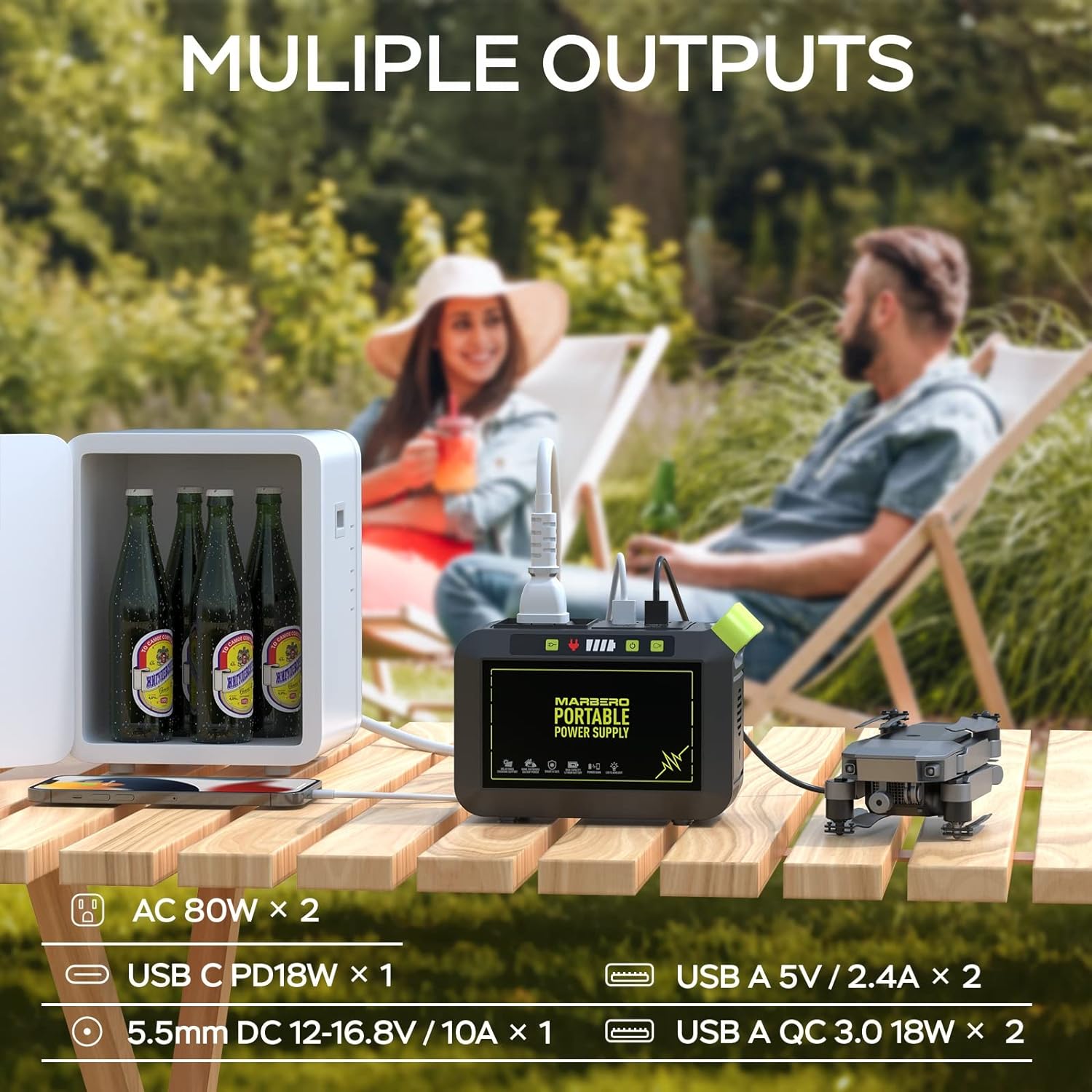
| EDITOR'S PICKVTOMAN Jump 600X Portable Power… | Mid-tierJackery Portable Power Station… | Budget pickMARBERO Portable Power Station… | |
|---|---|---|---|
| Battery capacity | 299Wh | 292Wh | 88Wh |
| AC output (peak) | 1200W | — | 120W |
| DC output | 3x 12V/10A | — | — |
| USB-C output | PD 60W | — | — |
| Battery chemistry | LiFePO4 | LiFePO4 | — |
| Jump start | ✓ | — | — |
| Price | $227.99 | $188.99 | $79.99 |
| See on Amazon → | See on Amazon → | See on Amazon → |
Why the 300Wh–1kWh Window Is Its Own Category
The entry-level units (Goal Zero Yeti 200X, Jackery Explorer 240) are fine for keeping phones and a few lights alive over a weekend. The full 2kWh+ systems start to approach residential battery backup territory — heavier, pricier, and usually better suited to a fully built-out van with a fixed roof-mount solar array. The 300Wh–1kWh middle band is where most serious car campers and beginning-to-intermediate van lifers actually land, and it’s the segment where the tradeoffs are least obvious.
What lives in this band:
- Jackery Explorer 500 / 1000 Plus
- Bluetti EB70S / AC180
- EcoFlow Delta 2 (512Wh) / Delta 2 Max (2kWh, upper edge)
- Goal Zero Yeti 500X / 1000X
- Anker SOLIX C800 / C1000
Each of these targets a slightly different use case, and the spec sheets — while honest — don’t always tell you which one you are.
The Core Tradeoff: Capacity vs. Output Power
Here’s the distinction that most buying guides gloss over: watt-hours (Wh) tell you how much energy the unit stores; watts (W) tell you how fast it can deliver that energy at any given moment. You need both numbers to match your reality.
Capacity (Wh): How Long Will It Last?
A 500Wh station doesn’t power a 500W device for one hour — you lose roughly 10–15% to inverter conversion inefficiency, more if the battery is cold or near depletion. NREL’s distributed storage integration research consistently models usable capacity at around 80–90% of rated capacity under real-world residential conditions; portable units in the field run toward the lower end of that range.
Quick load math:
| Device | Typical Draw | Hours from 500Wh (at 85% efficiency) |
|---|---|---|
| Laptop (65W) | 65W | ~6.5 hrs |
| 12V compressor fridge (40W avg) | 40W | ~10.6 hrs |
| CPAP without humidifier (30–40W) | 35W avg | ~12 hrs |
| Mini projector (50W) | 50W | ~8.5 hrs |
| Phone charging (18W fast-charge) | 18W | ~23 charges |
Run the fridge plus a laptop at the same time and you’re drawing ~105W — your 500Wh unit lasts roughly 4 hours of continuous combined load. That math is the most important sentence in this article. Do it for your actual gear before you click buy.
Output Power (W): Can It Run What You Need Right Now?
Capacity is how big the tank is. Output power is how wide the pipe is. A 1kWh unit with a 500W inverter cannot run a standard coffee maker or a hair dryer — those draw 1,000–1,800W. But for van life and car camping, 500–800W AC output is usually adequate unless you’re running power tools or induction cookware.
Where this bites buyers: surge vs. continuous ratings. Compressor fridges, power tools, and small blenders spike 2–3x their running draw at startup. The EcoFlow Delta 2 is rated at 1,000W continuous / 2,600W surge peak (per manufacturer spec sheets), which handles most compressor fridge startups cleanly. Reviewers at Wirecutter note that units with lower surge ratings can trip their own protection circuits when starting compressor loads — a frustrating failure mode that’s easy to avoid by checking both numbers before purchase.
Battery Chemistry: The LiFePO4 vs. NMC Decision
This is the spec that most casual buyers skip and most experienced van lifers wish they’d paid more attention to.
NMC (nickel manganese cobalt): Higher energy density — more watt-hours per pound — so these units are physically smaller and lighter for a given capacity. The tradeoff is cycle life and safety margin. PV Magazine’s 2024 benchmark review of consumer storage chemistry puts NMC cells at roughly 500–800 full charge cycles before capacity degrades to 80% of rated. In van life terms, if you cycle the battery daily, that’s 1.5–2 years to noticeable degradation.
LiFePO4 (lithium iron phosphate): Lower energy density — heavier for the same Wh — but rated cycle life is typically 2,000–3,500 cycles depending on manufacturer and depth of discharge. That’s 5–9 years of daily cycling. LiFePO4 is also thermally more stable, which matters when a unit lives inside a vehicle that sees 110°F interior temps in summer.
CleanTechnica’s 2025 analysis of the portable power market flagged a clear trend: buyers with serious van life intent increasingly self-select toward LiFePO4 units even at a weight penalty, while car campers who take weekend trips are often better served by NMC’s lighter form factor.
The decision rule: If you’re cycling this unit 200+ times a year (van life or frequent overlanding), LiFePO4 cycle life math wins decisively. If you’re camping 15–20 weekends a year and want to carry the unit to a campsite by hand, NMC’s weight advantage is real and the cycle count math doesn’t punish you nearly as much.
Recharge Pathways: Solar Input Is the Variable Everyone Underestimates
A 1kWh station that can only accept 100W of solar input needs 10+ hours of direct sun to fully recharge — which doesn’t exist in most real camping days once you account for angle, clouds, and shade from trees. This is where input wattage caps become a critical spec.
Named units and their solar input ceilings (per manufacturer specs):
- Jackery Explorer 1000 Plus: up to 800W solar input (with multiple panels in combination)
- EcoFlow Delta 2: up to 500W solar input
- Bluetti AC180: up to 500W solar input
- Goal Zero Yeti 1000X: up to 600W (with Yeti Link expansion)
For a 500Wh unit, a single 200W panel in good sun can realistically deliver 4–5 hours of net-positive recharge — enough to offset moderate daily use. For a 1kWh unit, plan for two panels or a higher-input model unless you’re also recharging via shore power or your vehicle’s alternator.
Alternator charging note: Most units in this tier support 12V DC charging via a car port, typically at 8–12A — roughly 96–144W. At that rate, a 1kWh unit takes 7–10 hours of driving to fully recharge from empty. That’s a cross-country drive, not a 45-minute grocery run. Owners of larger units consistently report that alternator charging works best as a supplement to solar, not a replacement.
Consumer Reports’ evaluations of portable power stations have repeatedly flagged charging rate transparency as a weak point in product marketing — the headline “recharge in 1 hour” almost always refers to simultaneous AC + solar + DC input stacked together, not any single source.
The “If X, Then Y” Decision Framework
You’ve done the load math, you know your chemistry preference, and you understand your recharge pathway. Here’s how to close the decision:
If you’re car camping 1–3 nights and primarily need power for phones, a laptop, lights, and an occasional blower fan: A 300–500Wh unit is the right ceiling. The Jackery Explorer 500 or Bluetti EB70S covers this cleanly, costs $300–$500 street price (as of mid-2026), and doesn’t saddle you with weight you don’t need. NMC chemistry is a reasonable trade at this use frequency.
If you run a 12V compressor fridge full-time (van life or overlanding 4+ days): Your fridge alone consumes roughly 30–50Wh per hour. Over 24 hours, that’s 720–1,200Wh just for food preservation. You need either a 1kWh+ unit paired with at least 200W of solar, or a dedicated 12V battery system (separate from your starter battery) feeding the fridge directly — with the power station handling AC loads. Many experienced van lifers run a dual-system approach for exactly this reason.
If you’re building your first van and want one unit to do everything: Target 1kWh with LiFePO4 chemistry and at least 400W solar input capacity. The EcoFlow Delta 2 Max or Bluetti AC180 sit at this intersection. Expect to spend $700–$1,100 for the station plus another $300–$600 for panels. Budget $1,000–$1,700 total for the power system — that’s the realistic entry point for functional van life power.
If weight is the primary constraint (backpacker-adjacent car camping, solo travel): NMC units at 500Wh can weigh 12–14 lbs versus 16–22 lbs for a LiFePO4 equivalent. That delta is meaningful if you’re lifting it in and out of a hatch frequently. Accept the cycle-life tradeoff knowingly.
If you already have a system and are considering upgrading: Check whether your current unit supports expansion batteries before buying a replacement. Bluetti’s B80 and B230 expansion modules, for example, plug into compatible AC-series stations and extend capacity without replacing the inverter and charge controller you already own. Upgrading a compatible station can be 30–40% cheaper than buying a new higher-capacity unit outright.
One Honest Caveat Before You Buy
Spec sheets are optimistic in two consistent ways: rated capacity assumes room-temperature conditions and a new battery, and recharge time claims assume ideal solar irradiance (1,000 W/m²) that rarely occurs outside the Mojave at noon in June. Build a 15–20% buffer into your load math, assume your solar panels deliver 70–80% of their rated output in typical camping conditions (per NREL solar resource modeling for mid-latitude sites), and you’ll arrive at expectations the unit can actually meet.
The best power station is the one sized correctly for your honest load — not the one with the biggest number on the box. Do the math once, buy right, and it will follow you on every trip without drama.