If you’ve been looking at your utility bill after a multi-day outage and wondering whether a large “solar generator” — a portable battery system paired with solar panels — could have kept your household running, you’re asking exactly the right question. These kits combine a battery pack (measured in kilowatt-hours, or kWh — think of it as a bucket of stored electricity; one kWh runs a standard refrigerator for about 12 hours) with foldable solar panels that recharge the battery from sunlight. At the 3 kWh-and-up tier, we’re talking about systems that can power a refrigerator, a few lights, phone chargers, and a medical device like a CPAP machine simultaneously — not just a phone and a lamp. This article is for buyers who have already moved past “is this worth considering?” and are now in the harder place: figuring out which system, at what price, actually makes financial and practical sense for their specific situation — and whether the payback math holds up against a fixed whole-home battery like the Tesla Powerwall 3.
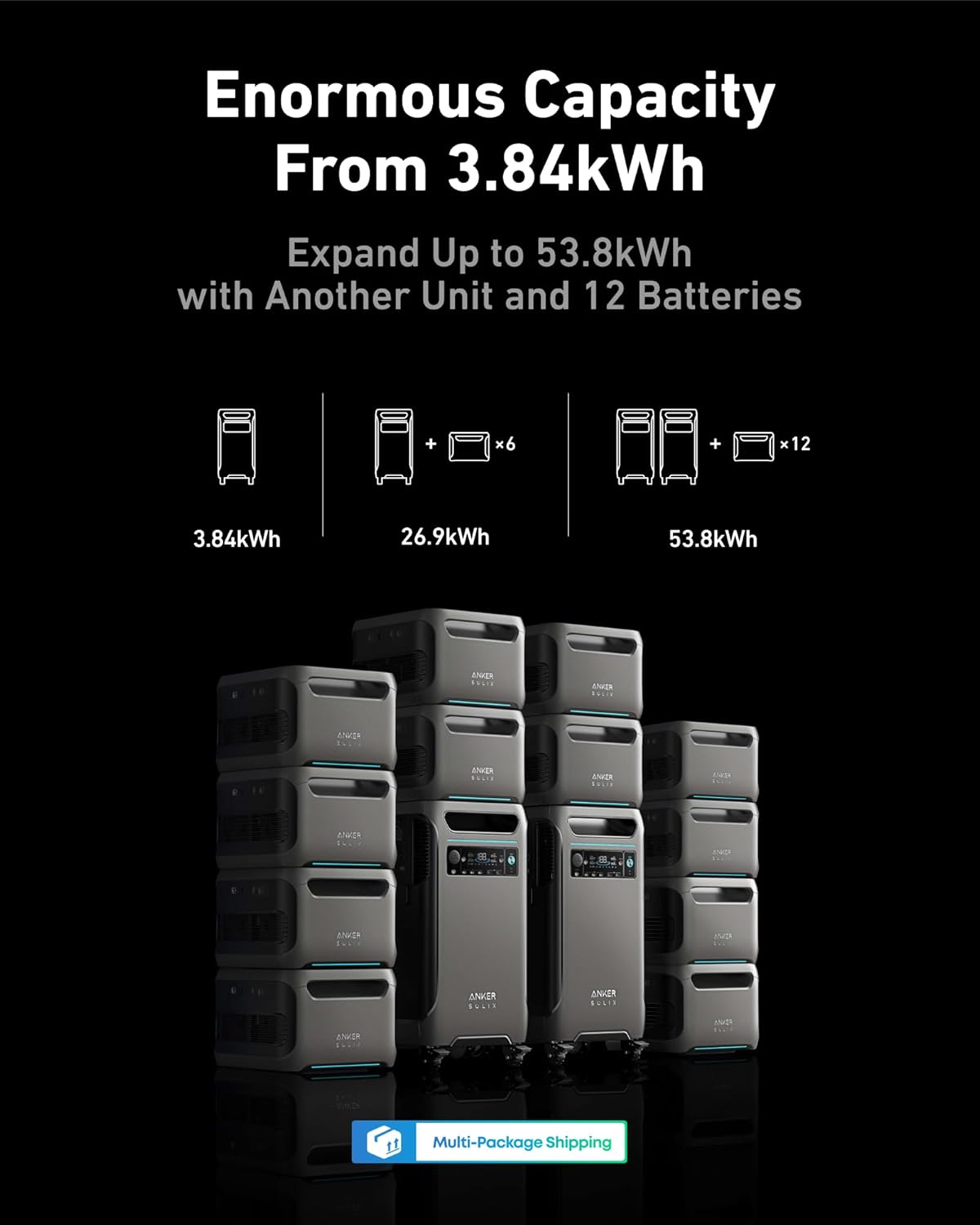
| EDITOR'S PICK[Anker SOLIX F3800 Portable Powe…](https://www.amazon.com/dp/B0C5C9HMQ2?tag=greenflower20-20) | Mid-tier[GROWATT HELIOS 3600 Portable Po…](https://www.amazon.com/dp/B0DF7SZJWY?tag=greenflower20-20) | Budget pick[Renogy 400W Portable Solar Pane…](https://www.amazon.com/dp/B0F4JR1PFM?tag=greenflower20-20) | |
|---|---|---|---|
| Battery Capacity | 3840Wh | 3600Wh | — |
| Max AC Output | 6000W | 7200W | — |
| Dual 120/240V | ✓ | ✓ | — |
| Battery Chemistry | LiFePO4 | LFP | — |
| Expandable | — | Up to 36kWh | — |
| Solar Panel Included | 400W | — | 400W |
| Price | $1,899.98 | $1,139.00 | $320.20 |
| See on Amazon → | See on Amazon → | See on Amazon → |
What You Actually Get in the 3–5 kWh Solar Generator Tier
Let’s establish the landscape clearly, because marketing copy in this category is aggressively optimistic.
The hardware stack. A typical large portable solar generator kit in 2026 consists of:
- A base unit (the power station itself) with a lithium iron phosphate (LFP) battery — LFP chemistry is favored here because it tolerates deep discharge cycles, poses minimal fire risk, and holds capacity over a longer service life than older lithium-ion formulations.
- An inverter built into the base unit that converts stored DC power to the AC power your appliances use. In this tier, continuous AC output typically ranges from 2,000W to 3,600W.
- One or more strings of foldable or semi-rigid solar panels, usually 200W–400W per panel, bundled or sold as an expandable add-on.
Prominent product families in this tier include the Jackery Explorer 3000 Pro (3,024 Wh), the EcoFlow DELTA Pro Ultra (6,144 Wh in its expandable configuration), the Bluetti AC300 with B300 battery modules (scalable from 3,072 Wh upward), and Goal Zero’s Yeti Pro 4000. These aren’t fringe products — PV Magazine’s 2025–2026 portable power station benchmarks identify this segment as the fastest-growing by revenue in distributed storage below 10 kWh.
What 3 kWh actually covers. Here’s a grounding exercise most product pages skip:
By the numbers — typical daily critical-load draw
- Refrigerator (Energy Star): ~1.2 kWh/day
- LED lighting (8 fixtures, 6 hrs): ~0.3 kWh/day
- Phone/laptop charging (3 devices): ~0.2 kWh/day
- CPAP with humidifier: ~0.5 kWh/night
- Total: ~2.2 kWh/day for genuine critical loads
A 3 kWh-rated unit — accounting for inverter losses (typically 10–15% per manufacturer specs) and the reality that you won’t discharge below 10–20% to protect battery life — delivers roughly 2.2–2.5 kWh of usable energy per cycle. That means one day of critical-load coverage per charge, or close to it. If you pair the unit with 800W of solar panels and you’re in a region averaging 4–5 peak sun hours per day (NREL’s PVWatts data puts most of the contiguous U.S. in this range), you can expect 3–4 kWh of solar recharge on a clear day — enough to run indefinitely through a daytime outage, and enough to top off overnight draws if the next morning is sunny.
The honest constraint: central HVAC, electric water heaters, and induction cooktops are not on this list. A 3 kWh portable system cannot run a 3-ton central air conditioner. Don’t let a 3,600W continuous output rating on the inverter confuse you — that’s peak delivery capacity, not stored energy. If you need to cover HVAC during a summer outage, you’re looking at either a much larger expandable system (EcoFlow’s Ultra line can scale toward 15 kWh with add-on batteries) or a fixed whole-home system.
The Payback Math: Portable vs. Fixed Storage — Show Your Work
This is where most buying guides go soft. Let’s be direct.
Scenario A: Occasional-outage household, moderate utility rate
Assume you’re in a state with an average retail electricity rate around $0.14/kWh (roughly the national average per the U.S. Energy Information Administration’s April 2026 Monthly Energy Review) and you experience 2–4 outages per year lasting 1–3 days each.
A mid-tier 3 kWh portable kit — say, a Jackery 3000 Pro with 2× 400W panels — retails in the $3,000–$4,000 range in 2026. It does not qualify for the federal Residential Clean Energy Credit (the 30% ITC) as a standalone product, because portable power stations without a permanent grid connection are not treated as “energy storage property” under IRS Notice 2023-29 and subsequent Treasury guidance unless they are charged exclusively from solar panels (the “charged solely from renewable energy” test). This is a critical nuance: if your kit is plugged into the wall for its primary charging, the ITC does not apply. If it is genuinely solar-charged, some taxpayers have successfully claimed the credit, but the IRS has flagged this gray area. Consult a tax professional before claiming it.
Without the ITC, at $3,500 installed:
- You’re paying $3,500 to avoid an estimated $15–$40 in utility costs per outage event (2.2 kWh × $0.14 × 2–3 days = trivial).
- The financial payback from avoided electricity cost alone is essentially never — outages don’t generate enough “savings” to recover capital.
- The real value proposition is comfort, food preservation, medical equipment continuity, and remote/off-grid utility — not rate arbitrage.
This matters for framing the purchase honestly: a portable solar generator is an insurance and resilience product. If you evaluate it as a financial return-on-investment vehicle against utility bills, the math will almost always disappoint.
Scenario B: Frequent-outage or time-of-use household, higher utility rate
Now assume you’re in California post-NEM 3.0, paying $0.30–$0.45/kWh during peak hours on a time-of-use (TOU) rate, and you’re also managing 5–8 PSPS (Public Safety Power Shutoff) events per year of 12–48 hours each. Or assume you’re in a rural area where outages are longer and a generator is your existing backup.
Here, the comparison shifts. A 3–5 kWh portable system vs. a gasoline generator is a legitimate financial comparison:
- A portable 3,500W gas generator costs $600–$900, but fuel during a 48-hour outage at 50% load runs roughly $40–$60 (EIA average gas prices, May 2026), plus maintenance and storage.
- The solar-charged portable system has near-zero marginal cost per outage once purchased.
- At 6 outages/year averaging 36 hours each: ~$280–$360/year in fuel savings vs. a gas generator.
- Payback on the $2,400 premium over the gas generator: roughly 7–9 years at this frequency.
That’s not a great return, but it’s a defensible one — and it doesn’t include the non-financial value of not storing gasoline, not dealing with carbon monoxide risk, and being able to operate indoors or in a garage.
Scenario C: Where fixed storage genuinely wins
EnergySage’s 2025 buyer’s guide and Wood Mackenzie’s Q1 2026 distributed storage outlook both flag the same inflection point: once a household wants more than 7–10 kWh of usable storage, or wants seamless whole-home automatic transfer (no manual plug-swapping), or wants to participate in utility virtual power plant (VPP) programs that pay for grid services, a fixed system like the Powerwall 3 (13.5 kWh, automatic transfer switch, VPP-capable) or Enphase IQ Battery 5P becomes the rational choice. At that scale, the 30% ITC applies cleanly (assuming the battery is charged from solar), the economics of rate arbitrage and VPP revenue begin to surface, and the installation becomes a capital improvement that adds appraised home value.
NREL’s 2025 residential solar-plus-storage economics report estimates that a solar-paired battery system in a high-rate state can generate $400–$800/year in combined bill reduction and VPP revenue — enough to justify a 10-year payback on a $12,000–$15,000 Powerwall system, especially with ITC applied.
What to Actually Look For When Comparing Kits
If you’re staying in the portable tier, here’s the comparison framework that matters in practice:
LFP cycle life vs. competing chemistry. Manufacturer-rated cycle counts for LFP batteries at 80% depth of discharge typically land at 3,000–6,000 cycles (Bluetti, EcoFlow, and Jackery all publish these figures). At one cycle per day of heavy use, that’s 8–16 years of service life. Older lithium-ion NMC chemistries in cheaper units often rate at 500–800 cycles. This is the single most important spec for total cost of ownership.
Solar input ceiling and MPPT controller quality. The battery’s built-in MPPT (maximum power point tracking) charge controller — the component that optimizes how efficiently solar panels feed the battery — should be rated above your panel array’s peak output. A unit with a 1,200W solar input ceiling paired with 1,600W of panels leaves 400W of capacity permanently wasted.
Expandability. The EcoFlow DELTA Pro Ultra and Bluetti AC300+B300 architecture allow stacking additional battery modules without replacing the inverter/base unit. If you’re buying for today’s needs but want headroom, modular systems cost more upfront but are more capital-efficient over time than replacing the whole unit.
Passthrough charging. Can the unit power loads while simultaneously charging from solar? Most flagship units in this tier can; budget units often cannot, which matters during a long outage where you want to run appliances and recharge simultaneously.
Warranty depth. Jackery, EcoFlow, and Bluetti all offer 5-year warranties on their premium lines as of 2026. Owners in long-run review aggregators consistently flag warranty claim responsiveness as a differentiator — EcoFlow’s U.S.-based support infrastructure draws notably higher satisfaction scores in extended-use reports than some competing brands.
The Decision Rule
Here’s where this lands as a clear if/then framework:
-
If your primary need is resilience for critical loads during 1–4 day outages, you don’t have solar panels yet, and your budget is under $5,000: a 3–5 kWh portable solar kit is a reasonable, practical purchase. Evaluate it as insurance, not as an investment with financial returns. Prioritize LFP chemistry, 3,000+ rated cycles, and expandable architecture.
-
If you already have rooftop solar, are in a high-rate state, want seamless automatic backup, or are interested in VPP participation: the economics favor a fixed battery system. The ITC makes it meaningfully cheaper than it appears at sticker, and the long-run bill and revenue math starts to pencil. A portable kit in this scenario is a supplement, not a substitute.
-
If you’re comparing a portable kit against a gas generator for rural or frequent-outage use: the breakeven is real but long — roughly 7–9 years at current outage frequencies and fuel costs. The non-financial benefits (no fuel, no carbon monoxide, indoor-safe) are genuine and worth weighting if those factors matter to your household.
The 3 kWh-plus portable tier is not a toy, and it’s not a scam. It’s a genuinely capable resilience tool that the market has finally priced into a range where the value proposition is honest. The key is knowing what you’re buying — and what you’re not.