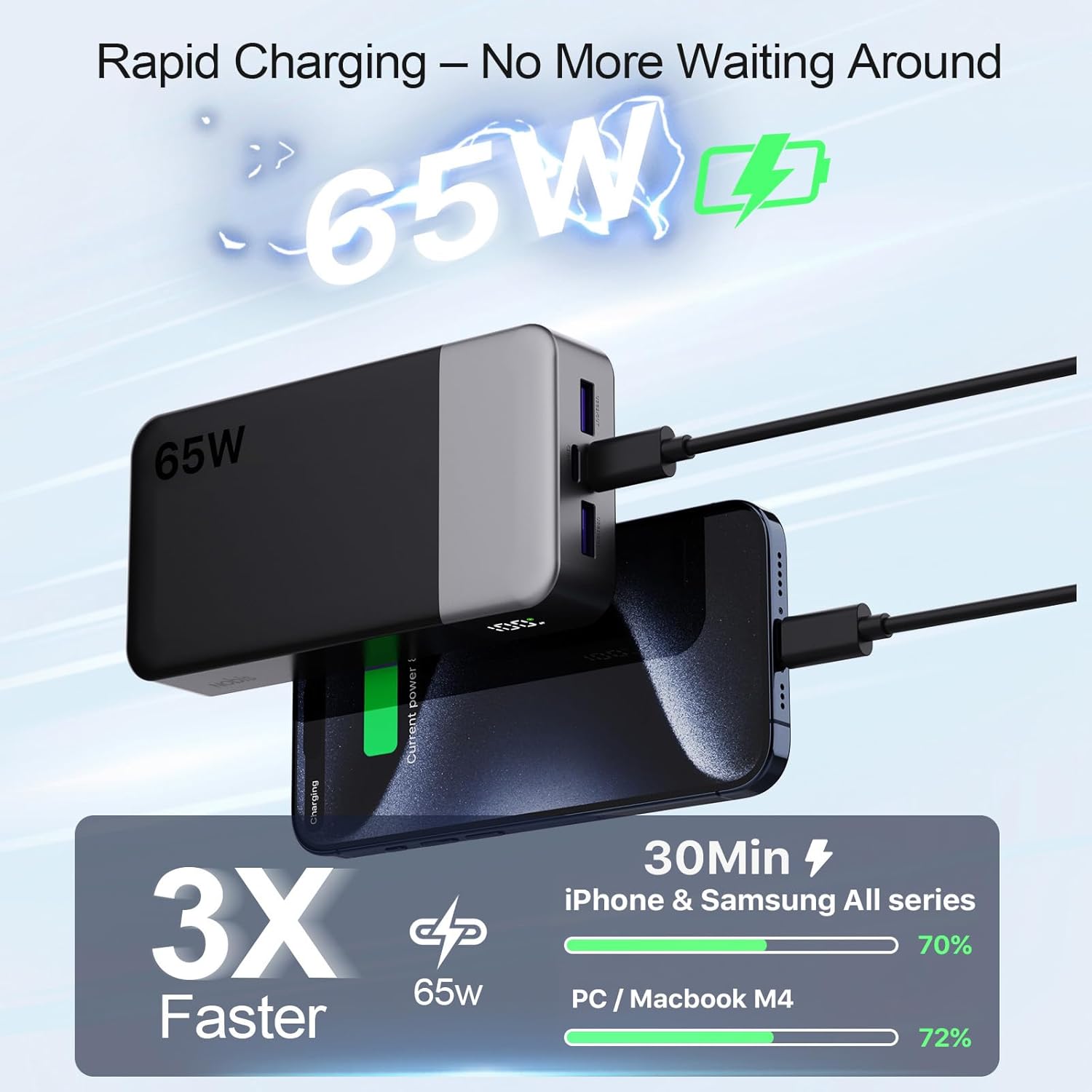
If you’ve ever shown up to a field site with a laptop dying at 40%, a thermal camera with a dead battery, and a 100W folding solar panel you’re not sure will actually charge anything useful — this article is for you. A portable power station is essentially a large rechargeable battery in a box, with built-in outlets (regular AC wall-style plugs), USB ports, and a charge controller (the circuit that regulates incoming power from a solar panel so it doesn’t damage the battery) all integrated. These are not the thin slab power banks you use to top off a phone. We’re talking about units that range from about 240 watt-hours — enough to run a laptop through a full workday — up to 3,000+ watt-hours, capable of running power tools, drone charging stations, or a mobile office for multiple days. For anyone doing serious field work tied to renewable energy systems, the right portable power station isn’t a convenience item; it’s a productivity-critical tool. This guide will walk you through how to size one correctly, which battery chemistry to care about, and how to match it to a solar panel so recharge time doesn’t become the bottleneck on your job site.
Why “Phone-Charger Tier” Thinking Gets You Into Trouble
Most buyers start with a watt-hour number that sounds large and work backward. That’s the wrong direction. The right starting point is your actual load — the real power draw of the devices you need to run — and then you build forward to capacity and recharge strategy.
Here’s where practitioners get tripped up: watt-hours (Wh) tell you total stored energy, but watts (W) tell you how fast a device pulls from that store. A unit rated at 1,000 Wh sounds impressive until you plug in a 500W inverter-driven power tool, which drains it in under two hours. Conversely, a 300 Wh unit can run a 30W laptop for roughly eight hours of actual use — which covers most field days.
The second trap is confusing peak (surge) watts with continuous watts. Power stations list a continuous output wattage and a peak surge rating. A motor-driven tool — a drill, a small compressor, an HVAC diagnostic unit — pulls two to five times its running watts for the half-second it takes to start. A unit rated 1,000W continuous but only 1,500W peak will trip its overload protection the moment you pull the trigger on a 14.4V hammer drill. Wirecutter’s coverage of portable power stations consistently flags this as the number-one cause of frustrated returns in the prosumer-and-above category.
The load math that actually matters:
| Device | Typical Running Draw | 4-Hour Field Day Load |
|---|---|---|
| Laptop (15”) | 45–65W | 180–260 Wh |
| Thermal / IR camera charger | 20–40W | 80–160 Wh |
| Drone rapid charger (2 batteries) | 80–120W | 160–240 Wh |
| Job-site LED work light | 20–50W | 80–200 Wh |
| Realistic total | 165–275W running | 500–860 Wh |
That table should immediately recalibrate anyone shopping in the 300 Wh tier for serious multi-device field days. The practical minimum for a full kit supporting a solar technician, energy auditor, or facilities assessment crew is 600–1,000 Wh usable capacity, which means a unit rated 700–1,200 Wh nameplate (accounting for depth-of-discharge limits and inverter conversion losses of 8–12%).
Battery Chemistry: LFP vs NMC and Why It Matters More Than Brand
This is the decision with the longest tail. The two chemistries you’ll encounter in this wattage tier are lithium iron phosphate (LFP) and lithium nickel manganese cobalt oxide (NMC).
NMC is energy-dense, meaning you get more watt-hours per pound — important if you’re backpacking to a site. It also charges faster. The tradeoff: NMC degrades more quickly under repeated deep cycling and high-heat conditions, and it carries a slightly elevated thermal runaway risk, which the U.S. Department of Energy’s battery safety guidance (energy.gov, Portable Power Station Safety and Lithium Battery Standards Overview) explicitly flags as a factor in storage and transport decisions.
LFP runs cooler, tolerates deeper and more frequent charge/discharge cycles, and has a published cycle life that typically runs 2,000–3,500 cycles before dropping to 80% capacity — versus 500–1,000 cycles for most NMC units under similar conditions. PV Magazine’s analysis of field longevity data (PV Magazine, “LFP vs NMC Battery Chemistry: Field Longevity and Cycle Data”) shows LFP’s durability advantage becomes decisive for users who are recharging daily from solar — exactly the use case this article addresses. The weight penalty is real: a 1,000 Wh LFP unit typically runs 22–28 lbs versus 17–22 lbs for an equivalent NMC unit.
Decision rule here is simple: If you’re mobile and weight is genuinely constrained (rooftop work, single-technician deployment), NMC in the 500–700 Wh range is defensible. If you’re running a basecamp, truck-bed kit, or any setup where the unit gets daily solar cycling, LFP’s cycle life makes it the obvious call — the premium pays back in unit longevity alone within 18–24 months of regular use.
Solar Recharging: Matching Panels to Power Stations Without Leaving Half Your Panel’s Output on the Table
This is where most intermediate buyers have a gap. Owning a 200W folding panel and a 1,000 Wh power station doesn’t mean you’ll recharge in five hours. The actual math involves three variables: panel Voc (open-circuit voltage), panel Isc (short-circuit current), and the power station’s MPPT input window (the voltage and current range the unit’s charge controller is designed to accept).
Every power station has a maximum solar input voltage and a maximum input wattage. If your panel array’s Voc exceeds the station’s maximum input voltage — a common scenario when someone daisy-chains two 100W panels in series — the unit will either refuse to charge or, in cheaper units, risk controller damage. CleanTechnica’s overview of portable solar charging ecosystems (CleanTechnica, “Portable Solar Charging Ecosystems: Match Your Panel to Your Battery”) emphasizes that this mismatch is responsible for a significant share of the “solar input not working” complaints across forum discussions of prosumer units.
Practical sizing guidance:
- A single quality 200W panel in full sun (1,000 W/m² irradiance, panel at 25°C) delivers roughly 160–170W of real-world output after temperature derating and wiring losses — not the nameplate 200W.
- Most mid-tier power stations (700–1,500 Wh) accept up to 400–500W of solar input.
- Recharge time formula: Wh to recover ÷ average panel output (W) = hours. Recovering 700 Wh with a 160W effective panel output ≈ 4.4 hours of good sun. In a mixed-cloud field day (which NREL’s solar resource data, nrel.gov, shows averages 3.5–4.5 peak sun hours across most of the continental U.S.), plan on a full day of panel-connected charging to recover a 700–1,000 Wh unit from 20% to full.
- If recharge within a single day is operationally required, size your panel capacity to at least 50% of the unit’s Wh rating — a 1,000 Wh unit benefits from 400–500W of panel input, not a single 100W panel.
A note on MPPT vs PWM controllers in integrated units: Most units at $500+ now include MPPT (maximum power point tracking) charge controllers, which extract 20–30% more power from a panel than older PWM (pulse-width modulation) controllers under real-world partial-shade and temperature-variance conditions. If a unit at a lower price point specifies only PWM solar input, that’s a meaningful efficiency penalty in field conditions — worth factoring into effective cost per usable watt-hour.
Product Tiers Worth Evaluating in 2026
The market has consolidated meaningfully. Based on published specifications and patterns across aggregated reviews, here’s how the tiers stack up for practitioner use:
500–800 Wh / LFP tier (~$400–$700): Units from Jackery (Explorer series), EcoFlow (RIVER Pro and DELTA Mini), and Goal Zero (Yeti 500X and 1000X) anchor this space. Owners consistently report that EcoFlow’s X-Stream fast-charging input and its broad MPPT solar window make it the recharge-speed leader in this tier. Goal Zero’s ecosystem compatibility with its Nomad and Boulder panel lines is a genuine convenience advantage for buyers already in that ecosystem.
1,000–2,000 Wh / LFP tier (~$700–$1,500): This is where the serious field-kit decision gets made. Bluetti (AC200MAX, AC200P), EcoFlow DELTA 2 Max, and Jackery Explorer 2000 Pro compete directly. Spec sheets put Bluetti’s AC200MAX at a 900W solar input ceiling and dual MPPT — meaningful if you’re running 400W+ of panels. Reviewers at Wirecutter and across long-run owner accounts note that Bluetti’s build quality and port selection tend to age better than its pricing premium suggests.
2,000–3,600 Wh / LFP tier (~$1,500–$3,000+): Bluetti EP500 Pro, EcoFlow DELTA Pro, and Anker SOLIX F3800 operate here. The DELTA Pro’s expandability (additional battery modules stack to 25 kWh) makes it the natural bridge between portable power stations and entry-level whole-home backup — a relevant option for energy auditors who want to demo battery backup concepts to residential clients on site. Published specs on the Anker SOLIX F3800 put it at a 2,400W solar input capacity, which is the highest in the portable category as of mid-2026.
The Decision Framework: If X, Then Y
After working through specs, chemistry, and solar matching, here’s the clean decision tree for a practitioner with a current procurement decision:
If your daily load is under 400 Wh and weight is a hard constraint (single technician, frequent travel, rooftop deployments): NMC in the 500–700 Wh tier with a single quality 200W panel is sufficient and keeps system weight under 35 lbs combined.
If your daily load is 400–900 Wh and you’re recharging daily from solar: LFP in the 1,000–1,500 Wh tier with 300–500W of panel input. Budget for a unit with MPPT and a solar input ceiling above 500W. EcoFlow DELTA 2 Max or Bluetti AC200MAX are the benchmark units to evaluate here.
If you’re running a multi-person crew, basecamp, or mobile demo setup: LFP in the 2,000–3,600 Wh tier with expandable capacity. The Anker SOLIX F3800 or EcoFlow DELTA Pro’s modular architecture give you a growth path as load requirements increase without buying a new base unit.
If the unit will sit in a truck bed or enclosed trailer in summer heat: LFP’s superior thermal stability isn’t optional — it’s the only chemistry worth specifying. NMC’s performance degradation above 40°C (104°F) ambient is well-documented in the DOE’s battery safety literature, and a truck bed in July in the Southwest regularly exceeds that threshold.
The broader point — which NREL’s distributed PV balance-of-system cost research reinforces — is that field crews under-invest in power infrastructure until it becomes a job-site constraint. A $900 LFP power station that keeps your diagnostic tools running through a full commercial site visit pays for itself the first time it prevents a second mobilization. Size for the actual load, match the solar input to the recharge window you have, specify LFP if cycles are high, and the rest of the decision falls into place.