You’ve probably seen the ads: “Complete 400W solar kit — everything included, ships in two days.” For someone buying their first off-grid power system — a setup that generates and stores electricity independently from the utility grid, using solar panels, a battery bank, and control electronics — that bundle sounds like the whole answer in one box. And sometimes it is. But anyone who has purchased one of these kits and then spent a weekend on a forum troubleshooting a voltage mismatch knows the fine print matters enormously. The bundle price buys you a collection of components that were chosen to work together in theory. Whether they actually cover your loads (the appliances and devices drawing power), in your climate, with your roof or roof-rack geometry, is a separate question — and it’s the one this guide is here to help you answer before you click buy.
If you’re mid-decision on a kit — you’ve got a shortlist, a budget, and a departure date on the calendar — read on. The math is straightforward once you know which numbers to trust.
What a “Complete Kit” Actually Contains (and What It Doesn’t)
Every kit marketed as all-in-one bundles at minimum four components: solar panels, a charge controller (the device that regulates current from the panels to the battery to prevent overcharging), a battery or battery bank, and an inverter (which converts stored DC electricity into the AC power your standard appliances require). Most mid-range kits from Renogy, Jackery, and Goal Zero also include cabling, mounting hardware, and a basic monitoring display.
What almost no kit includes, at any price point: wire connectors sized for your specific cable runs, a proper fuse or breaker assembly, a battery monitor that tracks state-of-charge accurately over time, or any component that accounts for how much shade your specific panel location will see. These omissions are not accidents. They’re the places where the bundle price compresses, and where buyers fill the gap with follow-on purchases — often more than $150–$400 in aggregate, per aggregated owner reports on platforms reviewed by Solar Power World in their 2025 RV solar roundup.
The charge controller mismatch is the most common gotcha. Most entry kits under $600 ship with a PWM (pulse-width modulation) charge controller. PWM controllers are simpler, cheaper, and reliable — but they’re only efficient when your panel’s operating voltage is closely matched to your battery voltage. Upgrade to larger or higher-voltage panels and a PWM controller wastes 20–30% of your potential harvest as heat. MPPT (maximum power point tracking) controllers dynamically find the optimal operating voltage and recover that loss, typically improving yield 10–30% in real conditions, per NREL’s small-scale off-grid technical reporting. Kits that ship with MPPT controllers cost more upfront; the crossover point where that cost pays back depends on your daily sun hours (the number of peak-sun-equivalent hours your location receives per day, typically 3–6 across most of the continental U.S.).
The battery chemistry question is equally load-bearing. Through mid-2026, the dominant split in the kit market is between AGM (absorbed glass mat lead-acid) batteries and LiFePO4 (lithium iron phosphate). PV Magazine’s chemistry overview puts the usable capacity gap clearly: AGM should only be discharged to 50% of rated capacity to preserve lifespan, while LiFePO4 can safely use 80–90% of rated capacity. That means a 200Ah AGM battery actually delivers ~100Ah of usable power, while a 200Ah LiFePO4 delivers ~160–180Ah. If a kit advertises “200Ah battery” without specifying chemistry, the usable capacity difference is nearly 70% — a number that determines whether your refrigerator runs through the night.
Reading the Bundle Price: A Tier-by-Tier Breakdown
Here’s where the practitioner frame becomes useful. Bundle prices cluster in three tiers with meaningfully different component profiles.
By the numbers — 2026 kit market snapshot:
- $150–$400: 100–200W panel, PWM controller, no battery (or small AGM), suitable for phone/laptop charging and LED lighting only
- $600–$1,500: 200–400W panel(s), entry MPPT controller, 100–200Ah LiFePO4, adequate for a small fridge + lights + device charging for 1–2 days of autonomy
- $1,800–$4,500: 400–800W panels, quality MPPT (Victron, Renogy Rover Elite), 200–400Ah LiFePO4, pure-sine inverter 1,000–3,000W, designed for full cabin or large RV continuous use
The $600–$1,500 tier is where most RV buyers with a serious continuous-use need land, and it’s also where component quality variance is widest. Two kits priced at $1,100 can have meaningfully different inverter specs (modified-sine vs. pure-sine — a distinction that matters for motor loads like a compressor fridge or CPAP machine), different MPPT controller amperage ceilings, and different battery cycle-life ratings. EnergySage’s off-grid buyers guide notes that LiFePO4 batteries from reputable manufacturers are rated for 2,000–4,000 cycles to 80% capacity, while budget cells with the same label may deliver fewer than 800 cycles — a difference that’s invisible in the bundle price.
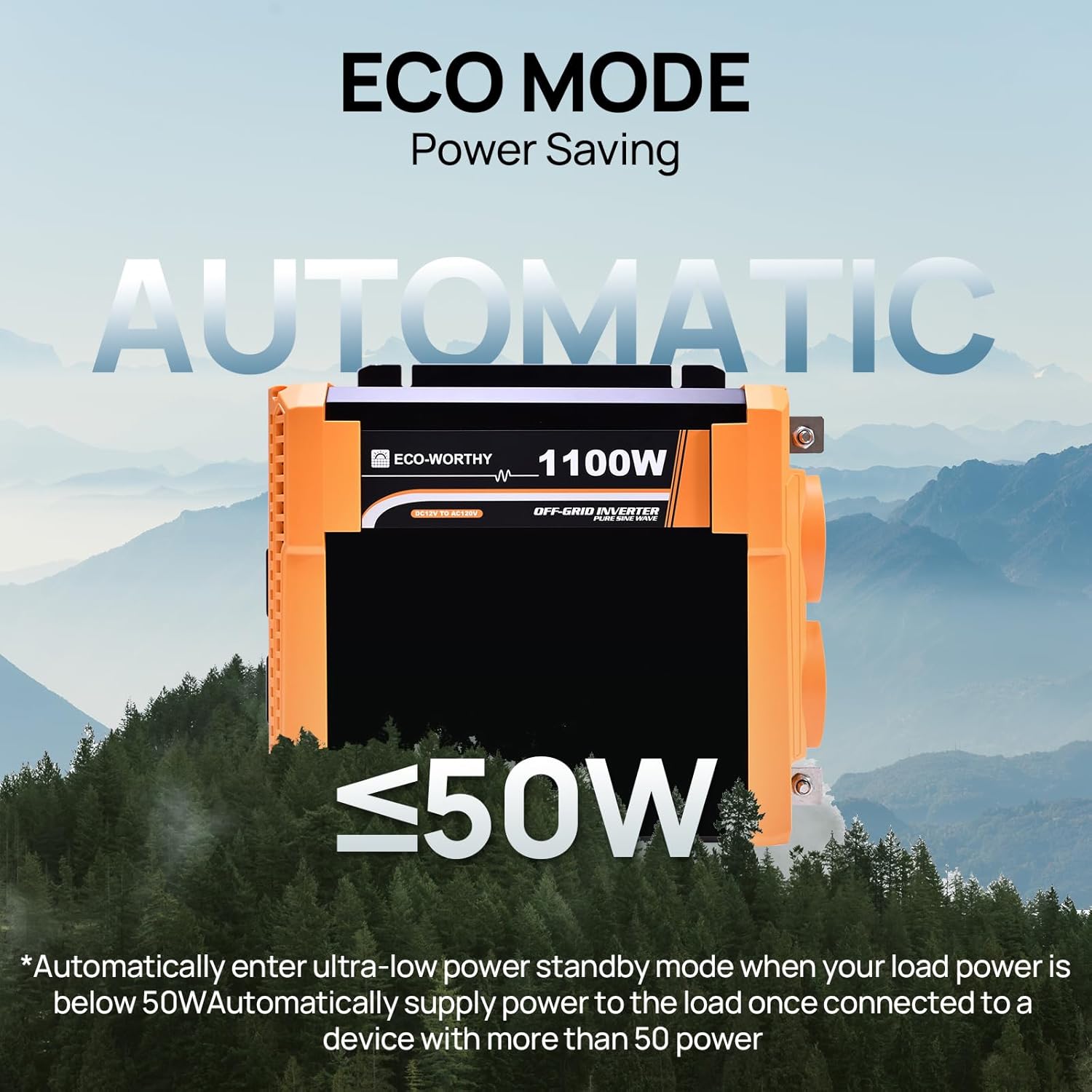
The inverter spec most buyers miss: inverter wattage is rated at continuous output, but surge capacity (the brief higher wattage required to start a motor) matters more for real-world use. A 1,000W continuous inverter with a 2,000W surge handles a small compressor fridge starting up; one with only a 1,200W surge may not. Published specs list both numbers; if a kit listing shows only one wattage, assume the lower figure and verify before purchase.
The Decision Frame: RV vs. Cabin vs. Mixed-Use
The use case isn’t cosmetic — it drives which bundle components matter most.
RV and van-life buyers prioritize weight, panel flexibility, and portability of the battery. A 200Ah LiFePO4 battery typically weighs 45–55 lbs; AGM equivalents run 55–65 lbs and are harder to move. Roof mounting geometry on vans is irregular enough that rigid panel kits often require supplemental flexible panels or a ground-mount adapter — neither of which is included in a standard bundle. Owners consistently report that the cable lengths included in most kits assume a textbook installation; real runs on an RV often require an additional 10–15 feet of appropriately gauged wire.
Remote cabin buyers have a different constraint profile. Weight matters less; autonomy (how many days the system runs without sun) and continuous AC load capacity matter more. A cabin with a full-size refrigerator, lighting, and occasional power tool use needs to solve for daily watt-hours in a way that an RV with 12V appliances doesn’t. The U.S. Department of Energy’s Energy Storage Grand Challenge Roadmap recommends sizing battery storage at 1.5–2x the expected daily consumption for off-grid residential applications where grid backup is unavailable. For a cabin drawing 1,500Wh/day, that means 2,250–3,000Wh of battery capacity — roughly 200–250Ah at 12V, or 100–125Ah at 24V. Most mid-tier bundles fall short of that for cabin use, which is a useful signal that the bundle is a starting point, not an endpoint.
Mixed-use buyers (seasonal cabin that also serves as a base camp, or an RV used at home between trips) should model the peak-use scenario, not the average. The system has to handle the worst-case day, not a typical Tuesday.
What to Verify Before You Buy (The Checklist That Saves the Headache)
Across aggregated owner accounts and Solar Power World’s 2025 market roundup, the failure points concentrate in the same places every time. Run these checks against any bundle you’re evaluating:
1. Is the MPPT controller rated for your panel array’s Voc? Voc (open-circuit voltage) is the maximum voltage a panel produces when not under load. Wire two 12V panels in series for a 24V system and the Voc can exceed 44V. Many budget MPPT controllers are rated to 50V input max; a 400W kit with four panels wired in series can blow that ceiling. Published specs on the controller’s input voltage range should exceed your array’s maximum Voc by at least 15%.
2. Does the inverter output pure-sine or modified-sine AC? Modified-sine is adequate for resistive loads (lights, simple chargers). Pure-sine is required for motors (compressor fridges, CPAP, pumps), sensitive electronics, and anything with a variable-speed drive. If the kit listing doesn’t specify, assume modified-sine.
3. What is the battery’s rated cycle life and under what conditions? Cycle life ratings assume a specific depth of discharge (usually 80%) and a temperature range (usually 25°C). LiFePO4 cells lose capacity faster below 0°C and above 45°C. If your use case includes cold-weather camping, verify the battery has a built-in low-temperature cutoff or internal heating element — a feature present in premium cells but absent in budget alternatives.
4. Is there a fuse between the battery and inverter? This is the single most common safety gap in bundled kits. A short-circuit between a fully charged LiFePO4 battery and an inverter without an inline fuse can cause a fire. Many kit listings photograph this component as optional. It is not optional. If the bundle doesn’t include it, budget $15–$30 and add it before first use.
5. Does the monitoring solution show real-time state-of-charge or just a voltage approximation? Voltage-based state-of-charge readings are notoriously inaccurate for LiFePO4 because the discharge curve is flat — voltage barely changes between 90% and 20% charge. A proper battery monitor (a coulomb counter, sometimes called a shunt-based monitor) measures actual current in and out. Victron’s BMV series and Renogy’s equivalent are the most commonly cited by owners as reliable; a basic voltage display tells you almost nothing useful.
The If/Then Decision Rule
If your use case is weekend RV trips with 12V appliances and USB charging only, a $400–$700 kit with 200W of panels, an entry MPPT controller, and 100Ah LiFePO4 covers you — the bundle math works.
If you’re running a compressor refrigerator continuously (the most common upgrade trigger), step up to a bundle with at minimum a 1,000W pure-sine inverter, 200Ah LiFePO4, and 300–400W of panels. Budget $1,200–$1,800 and verify the inverter surge rating explicitly.
If you’re powering a remote cabin as a primary residence or frequent-use structure, no standard kit bundles enough capacity — treat any bundle as a phase-one purchase and plan to add battery capacity separately. Size the battery bank first based on your daily load audit, then work backward to panels and controller.
The bundle price is real. What it buys you is a vetted starting configuration — not necessarily a complete system for your specific loads. Knowing the difference before you order is the whole game.